Field of Science

Friday Fabulous Flower - Closed?


A friend once brought a picture of this plant to me and asked why don't the flowers ever open.  An interesting question surely.  TPP once studied a tropical flower that looked quite open but wasn't functional until it reclosed.  But this is called the bottle gentian, Gentiana andrewsii, and the flowers don't open any more than this.  It takes a big robust pollinator, like a bumblebee, to force its way into the flower, and in the process move some pollen around.  This is an interesting way for the plant to select a particular pollinator.  Sorry honey bee, you can't pollinate this native plant.  This can make a nice addition for fall, partial shade flowering.  Someone is bound to ask about when do the flower buds open.

Birthdays during a pandemic

There is no good time to have a birthday, and certainly not during a pandemic.  TPP's usual birthday celebration involves feeding a lot of fresh seafood to a bunch of friends who are happy to help you.  And it doesn't get any better than that.  But lots of things have been conspiring to make TPP feel old, and mostly because he is getting old.  As one T-shirt given to TPP says "Survived the 60s twice"  This is a good thing because lots of old friends have already died, so having birthdays is much better than not having any more birthdays.  On a bit of a lark, family and oldest friends find ourselves in very rural south central Missouri, a state where TPP spent a couple of years once upon a time.  The idea was to get away from people and just feel normal for a few days, eating and drinking and messing around like there was no pandemic.  Rented a rather plush farmhouse for the purpose, and the outdoor shower and toilet are first class.  The weather is comfortably warm during the day and cool at night.  Their spring-fed stream provides a nice swimming hole and lots of nice surrounding natural areas.  Just no seafood.  So far we have been quite lucky and none of our close friends have gotten sick during this pandemic, and this is most excellent so far, but you do begin to feel that you life has gotten a bit impoverished defined by things that you cannot safely do.  We were hiking this morning and since we were outside, most people, not a large number, were maskless, but the path was not terribly wide. A small number actually thanked TPP for stepping aside.  Tomorrow is the actual birthday event, and nothing particular has been planned except maybe a carrot cake and a nice cocktail.  On the whole TPP is thankful for the respite even if only a few days.  Wish you could all come along.  The number of Trump signs here in Missouri is actually rather depressing.  How could so many decent people find this man an acceptable president?
Friday Fabulous Flower - Goldenrod

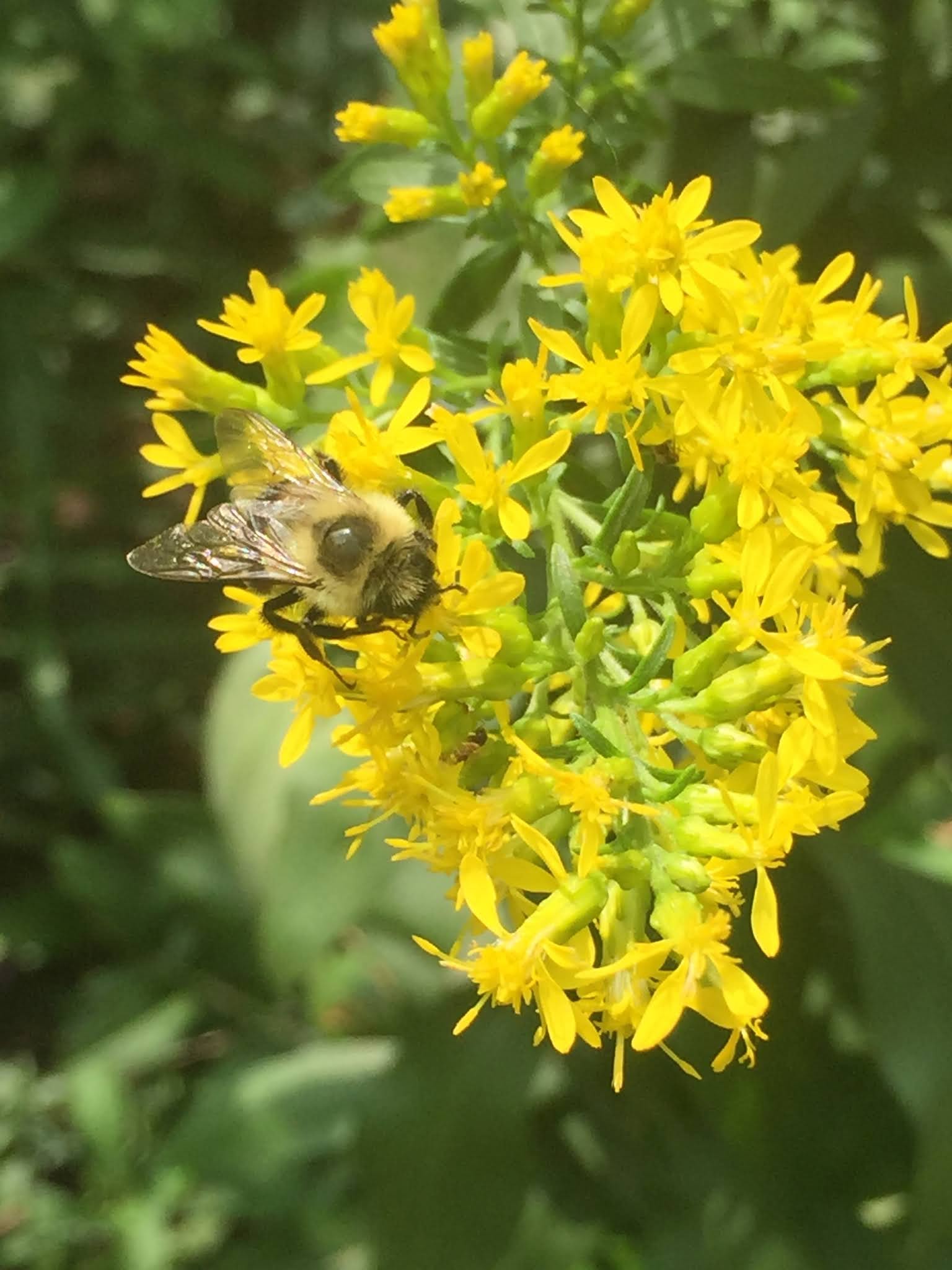
Late summer and fall are the flowering season of most goldenrods, and as a result they get a bad rap.  And since this happens virtually every year, let TPP explain.  This is also hay fever season and many people suffer from a pollen allergy, but let TPP assure you that goldenrod is not at fault.  Here's the general rule, if you see the flowers, that is, if they form a visual display, they are not wind pollinated, they are animal pollinated.  It's just that goldenrod happens to flower at about the same time as ragweed, whose flowers you never have noticed, but because it is wind pollinated it makes copious amounts of pollen.  TPP is not actually allergic, but his nose can tell when there is a lot of pollen in the air.  Most goldenrods have yellow-gold colored flowers that are rather small but clustered together to make a bigger display.  Goldenrods are in the Aster/daisy family (old name -Compositae; correct name - Asteraceae) and like daisies or sunflowers their heads of small flowers mimic large flowers by arranging ray flowers around the margin like petals, and using disk flowers to make the central button.  Goldenrods mostly just have small clusters, heads, of disk flowers, and this particular species, probably Solidago juncea, early goldenrod, has ray flowers too, looking like petals, and the insects really do love these flowers as the bee attests.

Friday Fabulous Flower - pretty red

This display certainly caught TPP's eye, and next hopefully some migratory birds eyes' too.  This is a nice illustration of a flower at the stage of seed dispersal, i.e., a fruit.  The actual fruit is rather cone-like and composed of a number of little follicles (like milkweed pods) that peel open exposing a pair of dangling seeds.  The seeds have a shiny dark brown to black seed coat.  But you don't see it here because the seeds are covered with a bright red-orange fleshy aril, which has a high lipid content to nourish those migrating birds.  
This is Magnolia virginiana in case you didn't recognize the flower at this stage.

Gardening in time of plague - Thoughts on this and that

TPP feels as though he has been a bit self focused and have not been doing much to be more generally informative to readers.  Some of it has come about because TPP doesn't have much to say about the foibles of academic life any more, and politics has just been pushing the angry button too often, so fewer blog posts in general and more of a focus on plants and growing them.  My first thought this morning, is quite simple, after a hiatus of more than 2 weeks, and many near misses, it is raining this morning, and we could easily use a couple of inches.  No idea yet if this will be adequate for the time being or not.  Later the rain gauge will provide some data.  This is better, and cheaper, than the last two days of spot watering to keep certain plants alive.
TPP has had to pay attention to Covid-19 whether he wanted to or not. A short get away trip has been planned, and the F1, who must be quite careful about this virus, would like TPP to limit his contact with strangers, especially the university's students, as the infection rate is rather high.  Unfortunately a colleague asked if an herbarium field trip were possible, and after initially saying, "yes", rethinking finds that this wouldn't be comfortable at the present time.  It is quite different than potting seedlings by himself in a closed greenhouse.
Here is a link to some thinking about the post-pandemic world that you might find interesting. The article is from a fellow FoS blogger.  It makes a lot of assumptions, but most are quite reasonable.  TPP has asked himself several times, how is this pandemic all going to end?  No good answers were forth coming, so good to have someone else's thinking about this, especially a microbiologist.
Almost fell prey to the need the coffee to make the coffee paradox, but noticed the lack of a suitable solvent just in time.  Usually putting in the water is first, but jumped forward too soon, ironically distracted by the rain. Drat rain is letting up already; not enough for sure.  
TPP finds himself sympathetic to the position of BLM protesters, and very sad that the situation is being used for politics as usual, which means a president bent on scaring the gullible.  And also as usual too many guns are involved.  Tom Tomorrow nails it as always.
Dear readers, have a nice day.


Friday Fabulous Flower - More red, redder, redest

A modest heat wave has turned a bit cooler, but still no rain for nearly 3 weeks.  Plants are very dry.  TPP has no choice but to water certain plants.  The big-leaf Magnolias, a newish Cephalotaxus, a struggling double file hydrangea.  However a couple of well established perennials or biennials were doing surprisingly well: several big blue Lobelias and very red Lobelia.  Usually the latter is associated with some moist places, but this plant is just in a typical enough mixed bed.  Lobelia cardinalis is just not a plant TPP has much luck with.  
Recently TPP told you that a Silene was about as red a flower as you can get, but forgot about this Lobelia.  And the hummngbirds love it.  

Gardening during time of plague - Chapter 4

TPP is retired so avoiding the university campus where Covid cases are increasing was not  a tough thing; but hanging out at home is getting a bit old.  The garden produce is keeping us well fed with fresh tomatoes, sweet peppers, eggplant, and zucchini with lots of basil.  Baby bok choi and lettuce have germinated for a fall crop.  And again some hot weather and drought have returned.  Water bill will be high again.  
Home improvement is our means of keeping people working during the ecomomic plague and it is also the season when nothing seen or heard is to be trusted.  It's going to be a long fall and TPP is so tired of this administration.  Can barely find the energy to say that the WH rose garden needed some work, but who ever did the planning has no sense of the garden aesthetic.  Bland would be TPP's assessment.  But the current occupants are not the sort of people who have a well developed aesthetic, and certainly this is the least of my concerns.  Botany is an international field and TPP is tired of apologizing for our country's bone-headed attitude.  Leadership is a terrible thing to squander. 
One gets the impression that our government wants us to be afraid, but neither god nor guns makes for safety although some people seem to think so.  Stupid conspiracy theories are favorites of the gullible. Saw a well-dressed young gentleman who sign proclaimed that he thought socialism sucks.  Personally libraries and public schools certainly don't suck that badly.  Hope his graduation depends on his understanding of socialism.  

Friday Fabulous Flower - Meadow rue

Well, another busy weekend kept TPP away from his laptop, so the FFF is late again.  A few late summer plants are flowering to provide a bit of choice.  Perhaps the most visually appealing are the magic lilies, the naked ladies, or whatever you call them are a late summer amaryllis and our gardens have hundreds of them in flower.  The leaves come up in the early spring along with the narcissi. But then they die down and provide no hint of the flowering to come.  Then in the first week of August, clumps of flowering stems shoot up 30 or so inches tall and bear an umbel of big pink flowers.  
Hidden in plain view are lesser flowers, and one of them is a meadow rue, a member of the buttercup family in the genus Thalictrum (the species is uncertain, maybe T. rochebrunianum).  The individual flowers are quite small, but the plant bears a spray of hundreds.  The colored parts are either anthers or bracts (in this case, surrounding quite a few stamens.). Ours were being visited by emerald green orchard bees.  

Friday Fabulous Flower - catch-fly

Today's, yesterday's, FFF is sure to add a splotch of color to your garden primarily because this is the reddest flower we have.  It tends to flower just after the mid-summer flowering doldrums, so it's bright red flowers are most welcome.  A friend walking through our gardens spotted the flowers and reached over to pull the plant a bit closer, and discovered first hand one of the more interesting common names, catchfly.  The entire aerial parts of the plant are covered in glandular hairs making it discustingly sticky.  Small insects do get trapped in the goo.  This is Silene regia, the so-called royal catchfly.  This is as close to a trouble free perennial that you can get.  

Friday Fabulous Flower - Mallow

One of the larger and gaudier flowers that you can easily raise is the rose mallow (Hibiscus mosacheutos).  Like all related flowers the large number of stamens forms a tube through which the style grows bearing a branched 5-parted stigma.  The flowers are huge, 8-9" across, and they are white, pink, rose, or red with red highlights (nectar guides) in their centers. Often this time of year when the rose mallows flower, the Japanese beetles appear and chew the crap out of the mallows and quite a few other plants too, although they do love the mallows.  This year for some reason the beetle population is quite small, do little to no damage.  These are herbaceous perennials, so they die back to the ground and grow new aerial shoots each year.