


Field of Science
-
-
Change of address1 year ago in Variety of Life
-
Change of address1 year ago in Catalogue of Organisms
-
-
Earth Day: Pogo and our responsibility1 year ago in Doc Madhattan
Showing posts with label goldenrod. Show all posts
Showing posts with label goldenrod. Show all posts
Friday Fabulous Flower - Goldenrod

Friday Fabuous Flower - SYC

This has been a hectic couple of days. The F1 bought a house (pretty exciting), the neighbor girl got married (also pretty exciting), the Phactors attended a memorial service for TPPs graduate mentor (kind of sad, but he lived a good, long life of continual learning), did too much driving in nasty traffic around Indianapolis (the hated loop), popped in to Jungle Jim's for a quick shopping trip (quite an adventure as always). That's rather way too much, oh, and several other invitations for this and that had to be declined for lack of time.
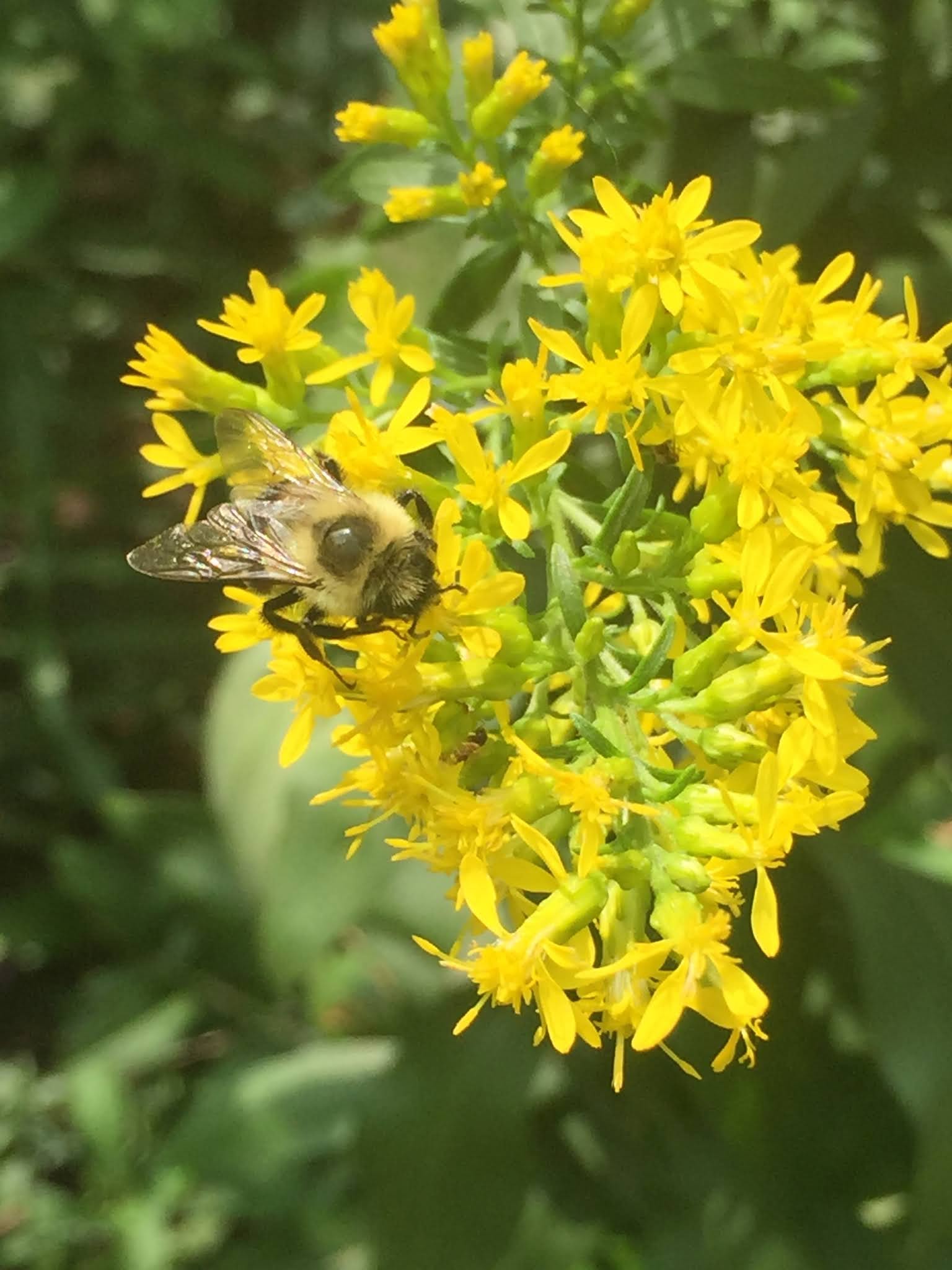
At any rate at this time of year, the pickings get a bit thin, and only SYCs are common (stinking yellow composites). This is a nice species for your wild flower garden, the showing goldenrod, Solidago speciosa. Like all composites (aster/sunflower family) goldenrods have little flowers in heads that include either both, or just disk flowers. The ray flowers are often mistaken for petals when they are arranged around the outside of flat-topped spiral array of disk flowers (think daisy). Most goldenrods have just ray flowers in rather small heads, but a few species have ray flowers too and these often help produce a quite showy display in this case 5 or 6 ray flowers surrounding a few disk flowers. The entire terminal cluster is being visited by a beetle, a bee, and a butterfly.
No, no, no, no, no - Goldenrod doesn't cause hayfever!
The fall allergy season is here, almost. The harvest season kicks up lots of dust and mold spores, and ragweed comes into flower soon. The local newspaper had a nice sidebar article about allergies and they mentioned all of these factors, BUT then some moron put a picture of goldenrod in bloom above the article! Now maybe they think goldenrod is ragweed, or that goldenrod causes allergies; wrong and wrong. Here's the problem: they both flower at about the same time, and most people see and recognize goldenrod, but they don't see or recognize ragweed. This is because goldenrod is insect pollinated; you should know this because the flowers are showy to attract pollinators. Ragweed flowers are green and seldom noticed as a result, but the plant is wind-pollinated so it must make a lot of pollen to blow around. Once again, TPP only wishes they would check with their friendly neighborhood botanist before doing such things; he doesn't charge much.
Good year for haploid males
 Enough about the weather, but since it is late summer, we must post on a topic TPP has visited before. This will be no surprise for people who suffer from hayfever, but this has been a very good year for haploid males, not all haploid males, but certainly those being dispersed by common species of Ambrosia (ragweed). The giant ragweed around here, and in one location it borders a jogging/walking/bicycling trail so thickly it's a wonder anyone can survive this pollen gauntlet, has done very well in spite of the drought. So for all you hayfever sufferers, it's looking like a bad season as the ragweed begins to flower and disperse it's tiny wind-dispersed males (pollen). Of course, many people here abouts blame goldenrods for their hayfever because they flower at about the same time as ragweed and having colorful flowers, they are noticed. However, colorful displays means they are attracting insects to disperse their pollen, and it isn't blowing around on the wind to be inhaled. The only thing that still puzzles TPP, and the answer has eluded me for years, is why were ragweeds named after ambrosia, something delightful to taste and smell, unless this was Linnaeus' idea of a joke.
Hay fever - It's ragweed, not goldenrod
At least once every late summer/fall season, TPP has to explain that it's ragweed that aggrevates your allergies, not goldenrod. Funny though, don't think it ever was in one of my blogs. Wonder why? No matter, the Annotated Flora has done a very nice job of explaining about this complete with pictures, but probably, someone will still ask. The general rule is simple: if something is gaudy enough for you to notice the flowers, then it isn't engaging in wind pollination and the pollen isn't getting into your nose. The same problem occurs in the spring because some people are allergic to pollen from trees with inconspicuous flowers and they bloom at the same time as black locust trees. But those big masses of white flowers are to attract insect pollinators, so unless a bee flies up your nose, black locust pollen isn't causing your hay fever.
Friday Fabulous Flower - Stiff Goldenrod
 Fall in the midwest and on the prairie is mostly about what we used to call SYCs, stinking yellow composites, an equivalent of birder's LBJs, little brown job. And yes, it takes a bit of work and experience to get beyond the it's a composite (aster/sunflower family) and yellow stage. Today's fabulous flower, flowers actually, is a favorite fall SYC that deserves to be in any perennial garden, the stiff goldenrod (Solidago rigida). The leaves of this plant are quite stiff with a rough surface, one of the many stiff, rough, prickly sort of things so abundant on the prairie in the fall. But what makes this goldenrod's floral display so fabulous are the ray flowers, which are only found in a handful of the 50 or so species in northeastern N. America. For those uninitiated to composites, each "petal" is actually a flower whose short tubular corolla has a single strap-like lobe. The corolla of the central disk flowers has five small lobes. In some of these little heads the disk flowers have yet to open. Lots of goldenrods flower this time of year, and because they are conspicuous, they often get blamed for causing people's fall-season hayfever, but because they are conspicuous they don't. Such conspicuous flowers are insect-pollinated, so the pollen doesn't end up inside your nasal passages, but the wind-pollinated ragweeds, also composites, with their very inconspicuous flowers are flowering at the same time.
Subscribe to:
Posts (Atom)