Field of Science
-
-
Change of address1 year ago in Variety of Life
-
Change of address1 year ago in Catalogue of Organisms
-
-
Earth Day: Pogo and our responsibility1 year ago in Doc Madhattan


GOP political experiments

The whole idea of experiments is that they allow you to see if things work they way you think they do. Generally this means TPP is growing plants under different conditions to factor their various needs. Seldom do you get experiments in politics. It took decades to discover that Reagan's trickle down economics doesn't work; the data are clear now, but still the idea persists. Money doesn't trickle down; the rich just get richer. Now the whole idea of cutting budgets to bring back prosperity is a very popular at the state level. So Michigan, how's it all working for you? Well, not so good really, and our democratic process seems to have been trashed out in the process. And who is it that ended up running things? Oh, somebody you never even got to vote for. So now what? Then there's the Kansas experiment. Imagine if the GOP had control of the legislature and the governor's office, why then the state could be put right, or so the argument went. So Kansas, how's it all working for you? Not so good, but then why did your re-elect Brownback? And now, even though things aren't going so hot fiscally, a pretty obvious result of disastrous policies, Brownback doubles down, keeps doing the same thing, while hoping for a different outcome! In some places that's considered crazy. Well, there it is. GOP ideas just don't work and GOP governors and legislatures have proven it. Thanks. It was a great public service. Hope people learn something, although of late the other party hasn't had any great ideas either especially here in Lincolnland. Maybe things will have to break really badly before some new ideas come forward.
Hot, steamy field work
Summer arrived rather quickly, as usual, and after all that rain, with some hot temperatures, all that vegetation and transpiration results in a very steamy environment, sort of a field work sauna. Not being crazy, such weather is sometimes avoided, but in this case some vegetation measuring needed to be completed as soon as possible, so there you go. As a result the work goes on and you put discomfort out of your mind as much as the nasty, annoying little gnats allow especially the ones whining in your ear. The data is now in the bank but the data gatherers are a bit worse for wear. Pass the Gaterade please. You remain thirsty for such a long time after you've gotten yourself dehydrated like that. Should have know better and had some water along, but well on the way to recovery now.
Well watered June gardens
The first week of June has left our gardens well-watered with 3-4 inches of rain. TPP had to remove water from the lily pond and will probably have to do so again today because of the 2.75 inches of rain in the last 24 hours. This is some 200-300% more rain than average. Fortunately the real heavy weather with high winds and hail passed just south of us. Can't remember when the low spots in our yard have been flooded so frequently. In late August and September it will probably be a drought. Too bad there's no way to store it all. Our rain barrel capacity is just 100 gallons. These weather fronts have our local conditions flip-flopping wildly, first aseasonally cool, cats-on-the-bed & blanket cool, now hot and steamy, a near 30F change in daily high temperature in one day. If you don't like the weather in the upper Midwest just wait a few minutes and it will change. Fortunately our neighborhood sits on a bit of a rise so no worries about damaging floods. People living on flood plains were watching out. All the rain has made weeds grow like crazy, and the only thing evening out the scales is that they are easy to pull when the ground is soft. The soft ground did assist with the removal of some wayward shrubs, spirea and a couple of old privets. TPP found a 6 foot tall pokeweed growing in a border garden; they easily get bigger, but not this early in the season. Welcome to summer.
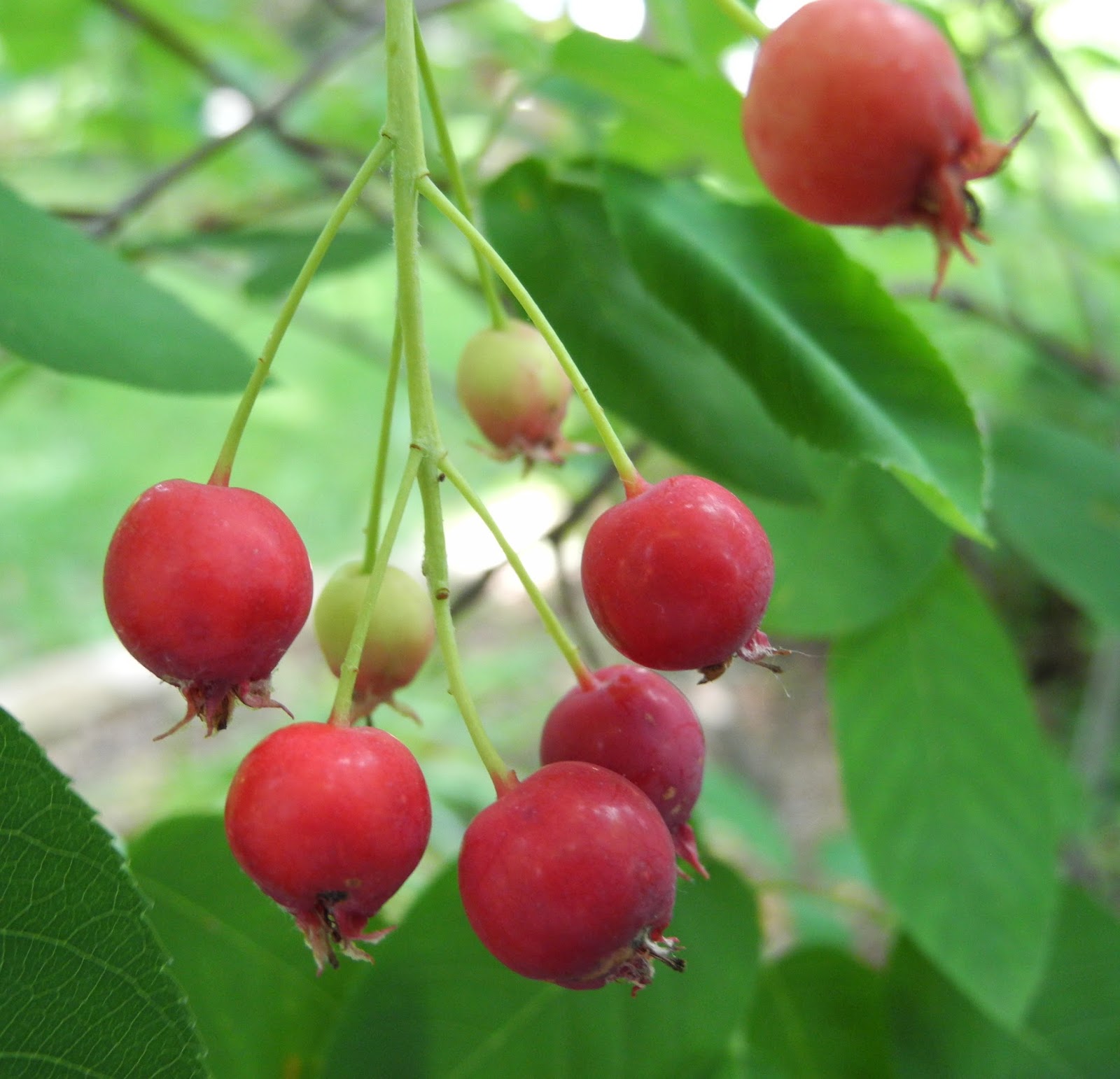
Friday Fabulous Flower - Juneberry
Big, old-fashioned rhododendron

Our earliest azalea (R. mucronulatum) bloomed just about 2 months ago, and the latest flowering rhododendron in our gardens is just now flowering. It's a bit old bush some 8-9 feet tall, 10-12 feet wide nestled between an oak tree (that doesn't like it), our house, and our fireplace chimney, and it has been their for decades. It was big when the house was acquired 15 years ago and the rhododendron bed was just enlarged around it. Unlike the many more compact mounded shrubs of modern varieties, this sprawling bush is what rhododendrons are supposed to look like, and still do in natural places. TPP has no idea what the name of this bease is, but he wishes you could still buy varieties that would grow like this, nothing the average gardener would want, but something for those of us who are not space challended. Among the scrambling stems, which tend to bend down and out, and then send new shoots back up, whorls of dark green leaves make a flat, round backdrop against which the pink inflorescences appear and bloom. This year the bush is covered making this shady corner of the garden something lovely to behold. If anyone out there has any ideas about the identity of this rhododendron, or where such varieties/species can be purchase, do please share.
Over enthusiastic reproduction
2015 has been a very good spring for the silver maples, which though rather ungainly and unattractive trees are quite common in our urban areas. Saying it was a good year only means the trees set an unusual abundance of fruit and seed. In places the samaras accumulated to more than an inch thick and our entire gardens were liberally sown with seeds from neighbors' large tree not that they were in any way at fault or could do anything about it. Now they are germinating everywhere! Even potted plants have a crop of maple trees coming up. Now when you think of this biologically, you get some idea about the odds of a single seed maturing into a forest tree and reproducing itself. Now deciduous trees like this can have reproductive lives measured in decades, yet in nature for a population to maintain itself exactly one offspring must on average survive and reach reproductive age. Just one! So what about all those seeds? Why such an overabundance of reproduction? First, the vast majority of such seeds are predated, consumed at this tender, energy rich, helpless stage. There are a lot of chubby squirrels around right now. Two, under some set of circumstances, a lot of offspring may get "lucky", so trees make lots of babies just in case. Three, it's a tough world out there, The odds of any single seed surviving and reproducing are really low, but the lottery is going to take place each year over decades. Woody perennials play for a win in the long-haul. Around here in our tamed ecosystems gardeners pull up the seedlings by the dozens, or they fall into lawns, or onto streets, or into gutters, something nature did not intend and if we didn't keep destroying all these baby trees our properties would pretty quickly become a forest of sorts. Yes, around here the climax community could be a tall grass prairie, but it takes fire to maintain the grassland and we don't like having fires around our houses so the woody plants would win. And win they will unless the Phactors remain vigilant about weeding.
Those pesky faculty - Wisconsin takes action
Several decades ago a dark comedy on the BBC was called "A very peculiar practice" and it was about academic life at Lowland University. The university had hired a new president from the USA to lead them forward, the appropriately named Jack Daniels, who decided they could save a lot of money by getting rid to the students and any non-revenue producing faculty. University faculty are a very pesky lot, and running a university without them might be an easier job, but not much educating is going to be getting done. Also the university won't be run very well because it will have adopted stupidly and foolishly the business model. You see, at a university, if run well,and ideas and governance run both up and down and across the organizational chart. Administrators who think things only travel down are soon confronted with textbook order forms (A colleague did this to the one-time chair of our governing board of trustees to demonstrate that in fact faculty did have a role in decision making.). Shared governance is an important part of a university's culture, and please understand, the faculty are usually looking out for the best interests of students and education. But faculty study things like science, and politics, and the like, and their authoritative manner, like they were experts or something, rubs a lot of politicians, and administrators, the wrong way especially when faculty forget who they work for, i.e., the state, for those us in public education. The GnOPe, which has been called the party of stupid for some obvious reasons, has been conducting a war on education, especially higher education, for some time now, and it's no surprise because university faculty tend to disagree with their governing ideology, their knowledge denial, and their social policies, and they can influence students too! Faculty do tend to be outspoken because our jobs are protected from retaliation by tenure by and large, unless you don't want to hear what faculty have to say. It's a great thing being a tenured full professor, let TPP tell you, and it's true his outspoken reputation might not be so great if protection against retaliation were not in place. So now just north of us, having gone after the unions, Wisconsin is turning its attention to dismantling what is arguably one of the great state higher educational systems including its flagship, the University of Wisconsin Madison. This will be done by cutting their budget, telling faculty to work harder (showing that those making the demand don't know what university faculty do or why they do it), and to make sure the faculty don't bitch too much, well, let's do away with tenure because the state should be able to fire state workers any time they want, for any reason. Now, these legislators and the governor don't think this will actually work out very well, but they don't care if it doesn't work well so long as they have enough teachers to train workers for the state. Oh, wait, that's one of the prime directives for universities in Lincolnland!
Essentials of growing grass

Socialism is the ism dismalest of all
If you don't recognize the title phrase, it's because it's from a Chad Mitchell Trio song from the 60s called "The John Birch Society". This morning TPP received a very important telephone call from some American Super-Patriot Think Tank (something like that), which means it's funded by some super-PAC and accountable to no one, sort of, not really. They excitedly wanted to tell me about the dangers of socialism as a threat to our 'Mercan way of life and that means Bernie Sanders is running for president. After politely listening for a few moments, TPP asked if this all meant capitalism was at risk? Yes, yes, most certainly it is. TPP suggested that having seen how badly capitalism was treating this country, its people, and its environment, some change sounds good. BTW they are meeting at the courthouse at 8 o'clock tonight.
Monday morning science
It's June; where did May go? Glad some early seed collection was done before our 2.25 inch rains came this past Friday and Saturday. Front ushered in some unseasonably cool weather, cool enough to send the kitty-girls back to our bed. Great news from the refrigerator! Seeds of yellow foxgloves (Aureolaria & Dasistoma) are germinating after several weeks of vernalization! Seed germination has sometimes been (and still is) a big problem with some of the species being studies. These are green, parasitic plants and they are going to be given different tree seedling hosts to assess the interaction from the perspective of both parties. Should be great fun. This afternoon will be more field work that now becomes even more pressing because you don't want long periods of time to pass between data gathering in plant communities during the growing season. And do they ever grow! Already marker poles are disappearing into the prairie canopy especially where the plots were nutrient enhanced. Always something to do this time of year.
Subscribe to:
Posts (Atom)