Field of Science
-
-
Change of address1 year ago in Variety of Life
-
Change of address1 year ago in Catalogue of Organisms
-
-
Earth Day: Pogo and our responsibility1 year ago in Doc Madhattan


Showing posts with label early spring flowers. Show all posts
Showing posts with label early spring flowers. Show all posts
Harbingers of spring

TPP had the opportunity to have a walk around the gardens. Signs of spring are everywhere. The witch-hazel are flowering, as are the snowdrops. Winter aconite is lifting its flowers and showing the bright yellow perianth, although it appears to be growing in a new location, so it seeded in or some new corms were planted and TPP doesn't remember. Now let's check the date: Feb. 25th. Yes, that's early, but witch-hazel has flowered earlier by a week or so on several occasions; this would set a new record for the winter aconite which has never flowered before March 5 before. This is only about 3 days earlier for snowdrops. No idea which of these harbingers is most reliable. The buds are swelling on the silver maple trees, and the filbert pollen catkins have elongated. Got a bit of snowy rain but nothing to really discourage these real early flowers. Picked a couple of forsythia branches to see it we can force some early flowers.
Friday Fabulous Flower - snow drops

Friday Fabulous Flower - dwarf daffodils

Friday Fabulous Flower - Tough guy edition

Friday Fabulous Flower - Purple fumewort

I'm dreaming of spring bulbs for Christmas
It's 61 degrees outside after a morning of thunderstorms that dumped a couple of inches of rain on us. Not only isn't this going to be a white Christmas, but spring bulbs: scilla, snow drops, daffodils, and spring beauty shoots are appearing all over the place. Helleborus niger flower buds are showing and Helleborus foetidus is flowering. TPP is surprised witchhazel isn't in flower. For two people who grew up in the snowbelt this is pretty unusual, but it's unusually warm across the whole eastern half of North America.
The Phactors got an alumni newletter the other day from Oswego State on the east end of Lake Ontario, and it listed the 10 biggest snow accumulation school years and Mrs. Phactor was there for two of the top 10 '69-'70 and '70-'71. Around 230" of snow each year. In '66-'67 TPP witnessed their largest single event snowfall, 102" in 32 hours!!! Hard to imagine isn't it? But both of us grew up in places that got 100-150" of snow a year, so it wasn't that big of a deal.
But the Phactors have gotten older and softer, so not sure how to handle that much snow any more. Glugwine and a fire place sounds about right. Mostly the spring plants will be OK especially if some snow finally provides some protection.
Oh, now the weather says expect winds up to 50 mph! At least the snow won't be drifting.
Friday Fabulous Flower - Blue lawn addendum
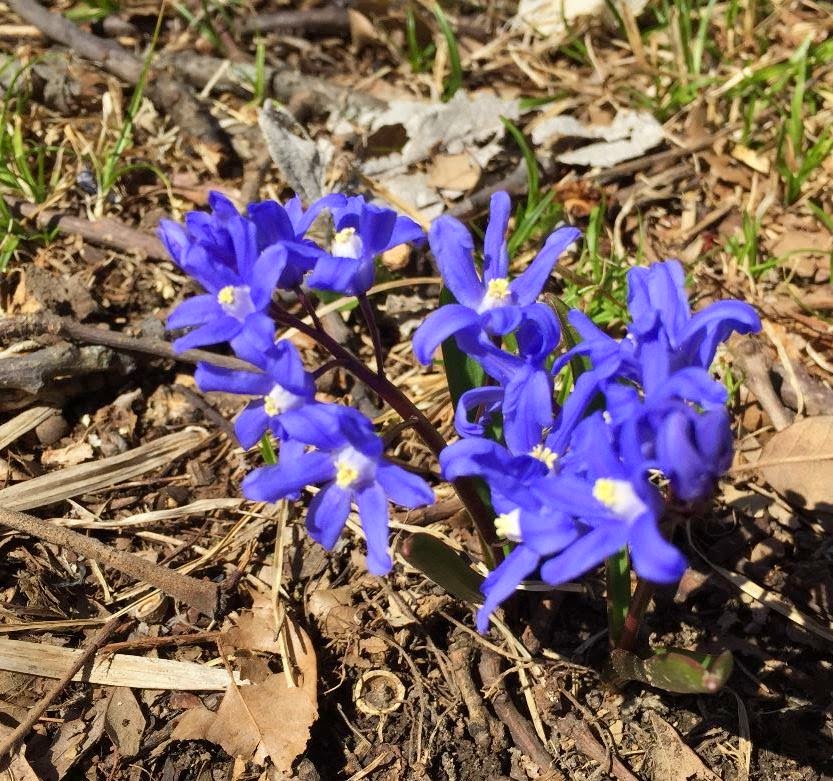 OK, who hit the publish button on the FFF blog on Thursday? Dang, no one else to blame, but my dear readers you will get another installment of blue as a result. While strolling through our blue lawn (Scilla version), someone wanted to know how many plants a blue lawn takes. Well, who knows, thousands and thousands; they been out there reproducing for a long time. So you sort of get used to them everywhere, and then one catches your eye, and TPP said, "That one is different." Closer inspection, i.e., get down to their level, revealed that TPP's sharp botanical eye has not dimmed in the least because indeed, among the many Scilla, was still another genus that is also bright blue, Chionodoxa, glory of the snow. This genus is (or was, the former lily family has been in upheaval.) placed close to Scilla, but they are pretty easy to tell apart. Not having planted this volunteer, an unconscious gift from some neighbor, the species is uncertain, C. forbesii perhaps, a common cultivar. As can be seen the petals are also bright blue, but some cultivars can be nearly white or purple. Here's the easiest difference; Chionodoxa has dilated stamen filaments, meaning flat, standing side by side making the center of the flowers white. The flowers also turn upward more, while the flowers of Scilla nod. Glory-of-the-snow can be pretty plentiful, but they never quite get as crowded as squill. And no, TPP isn't checking all the others.
Friday Fabulous Flower - Light blue lawns

Springy things
It's about time that some springy things happened. A few clumps of snowdrops are now in flowering. Both early and standard crocus have begun flowering, which sort of belies the "early" concept, and the proof is right there, the bits of yellow petals left from the bunny breakfast. Scilla is also starting to flower, although full flowering will be a bit later when the thousands and thousands of them will turn the lawn blue. This is just great; Scilla is not liked by bunnies so naturally the number around would overwhelm, even satiate, those herbivores if only they liked them. Finally the witch hazel has flowered and the American filbert isn't far behind. The lily pond pump was turned on not so much for the cascade, but for the leaf skimmer to gather up all the leaves that are blowing in. Just like swallows returning to someplace, mallards return to our lily pond every spring. And weirdly enough, the mallards joined the squirrels and bunnies under the bird feeder. Well, it is a bird feeder.
Subscribe to:
Posts (Atom)