Field of Science

Showing posts with label scilla. Show all posts

peak blue


 Sometime every spring right around the first of April, our garden's "lawn" turns blue.  This is caused by several thousand Scilla siberica bulbs.  It's a pretty remarkable sight.  It just takes a few decades to multiple. You can't walk with out stepping on them.  New neighbors are quite surprised at how blue the "lawn" becomes.

Peak Blueness is Late

If you search on "blue lawn", you will find a series of TPP posts on our blue spring lawn, which  is pretty spectacular and locally known.  This year is easily a week later than usual and as the temperature is predicted to get quite low tomorrow night it might be a bit short-lived too.  Many decades ago, someone planted Scilla siberica and they multiplied and prospered. Now there are thousands that have taken over portions of our lawn, as the image demonstrates, and it you don't mind waiting until they die down before mowing to avoid transforming the leaves into green slime, they are a great spring feature. How cheerful is that. Watch where you walk please.  

Peak blueness


Today is Peak Blueness.  It isn't as blue as some springs because of last week's shot of very cold weather and snow, although the latter doesn't harm these plants very much.  This is a portion of what passes for lawn at the Phactors.  The image was taken from a way back across our gardens and while the resolution does not allow it, the blue is the result of 10s of thousands of Scilla flowers. The Phactors haven't planted a one of these; they have been naturalizing and on their own for decades.  So plant them now for your future blueness. 

Friday Fabulous Flower - Blue lawn addendum

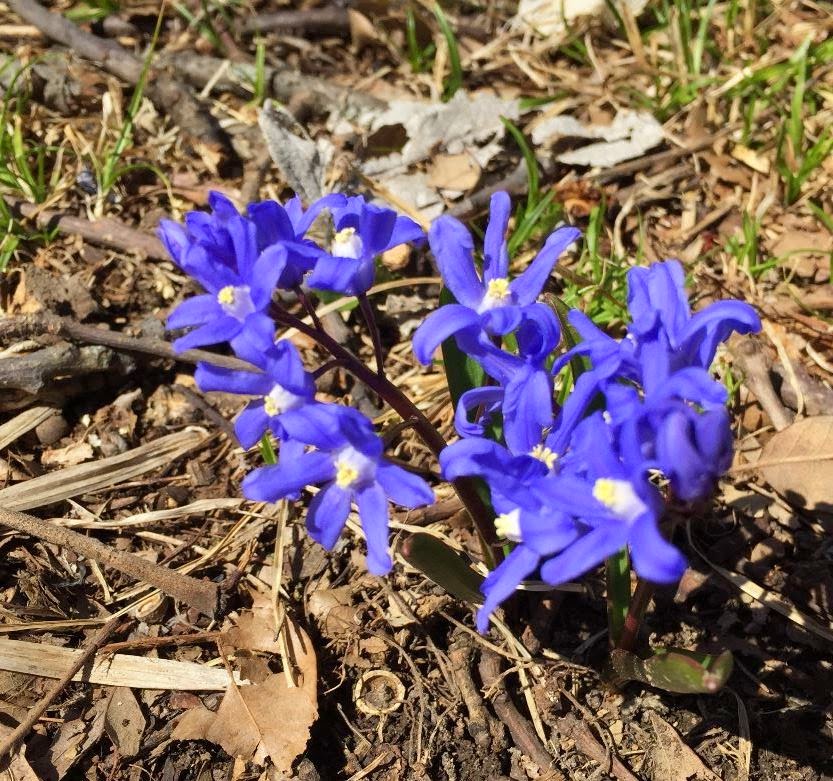
OK, who hit the publish button on the FFF blog on Thursday?  Dang, no one else to blame, but my dear readers you will get another installment of blue as a result. While strolling through our blue lawn (Scilla version), someone wanted to know how many plants a blue lawn takes. Well, who knows, thousands and thousands; they been out there reproducing for a long time. So you sort of get used to them everywhere, and then one catches your eye, and TPP said, "That one is different." Closer inspection, i.e., get down to their level, revealed that TPP's sharp botanical eye has not dimmed in the least because indeed, among the many Scilla, was still another genus that is also bright blue, Chionodoxa, glory of the snow.  This genus is (or was, the former lily family has been in upheaval.) placed close to Scilla, but they are pretty easy to tell apart.  Not having planted this volunteer, an unconscious gift from some neighbor, the species is uncertain, C. forbesii perhaps, a common cultivar. As can be seen the petals are also bright blue, but some cultivars can be nearly white or purple. Here's the easiest difference; Chionodoxa has dilated stamen filaments, meaning flat, standing side by side making the center of the flowers white.  The flowers also turn upward more, while the flowers of Scilla nod. Glory-of-the-snow can be pretty plentiful, but they never quite get as crowded as squill. And no, TPP isn't checking all the others.

Friday Fabulous Flower - Light blue lawns

Unlike in the burbs, the Phactors live in a historic district with old houses and old lawns, owned by old people (actually only a few of us) and here abouts, old lawns sometimes means blue lawns, virtual carpets of Scilla (squill) appear in the early spring.  On a couple of previous years, TPP has treated you to views of our blue lawn (here and here).  Our lawn will reach peak blueness either today or tomorrow, but these blues are quite cheerful. Lawns get this way when these little bulbs continue to reproduce unchecked for decades.  A couple of yards away a neighbor has a light blue lawn, which is really quite novel because the bulb is much less well known and much less commonly planted, and of course, these were planted some decades ago too. This is the genus Pushkinia.  This genus is native to the Middle East and is named for a Russian botanist.  The common name, although you seldom see it, is striped squill because of the bluish tint on the whitish petals is more or less a stripe. Some of these grow in one of our lawns, but it remains predominately blue.  Pretty cheerful, don't you agree? And some people only have grass.

Friday Fabulous Future Flowers - the blue lawn

The Phactors' blue lawn is almost upon us (which TPP has reported on before); the peak flowering of the thousands of Scilla bulbs that actually form a major component of our lawn in the spring. Dang, if we aren't going to be so busy that it'll be tough to find the time to enjoy the display. All that blue will be a minor pain in a few weeks, but right now all those blue flowers are a cheerful reminder than spring has sprung (and fortunately or unfortunately bunnies don't eat it).  It may be that so much squill exists because bunnies don't eat it. Decades ago someone turned this plant loose upon this property, and they've multiplied a bit. Way back there the yellow is Forsythia in flower. This year our the Forsythia flowers are toast (so this image is from last year) unless some survived below the snow line, but fortunately the dwarf forsythia or white (pinkish) forsythia (Abeliophyllum) is way more hardy.  If you don't have this smallish shrub anywhere in your landscaping (it is shade tolerant too), you really should consider it. And be careful where you plant your squill.

Blue lawn to green slime

A month ago a large portion of our lawn was a carpet of blue scilla.  It took decades for the scilla to multiply so prolifically, and it's a wonderful and lovely harbinger of spring.  What could be the problem?  A month has passed and lawns need mowing.  The blue lawn is now a verdant thicket of green scilla leaves, but they mow right?  Sort of.  The leaves of scilla contain a considerable amount of mucilage and moisture.  The discharge from you mower is basically green slime.  Generally the best strategy is to simply wait until the scilla leaves begin to yellow and fade before mowing the densest parts.  Even where the scilla isn't solid, it can get so slippery, you can barely get enough purchase to push the mower!  Ah, well, nothing's perfect. 

Friday Fabulous Flower - Blue lawn

A few years ago, quite a few years ago, somebody planted Scilla in the yard currently owned by the Phactors.  And in terms of naturalization, this introduction was more than a little bit successful.  Large portions of our lawns and gardens are now populated by hundreds of Scilla bulbs per square yard.  For a week or so the blue lawnt is quite charming, downright jolly, and a very welcoming sign of spring.  Later as the vegetation matures, these areas have to be avoided especially by the lawn mower or they get slimed by the mucilage in Scilla leaves.  Virtually nothing else grows in some of these areas at least until the Scilla dies back, and fortunately it does so by early summer.  In a fine color counterpoint, the Rhododendron mucronulatum, Korean azalea, also began flowering today displaying their clouds of bright pink flowers. You need this plant.  It's hardy, the easiest species to grow, and the earliest to flower.  The rest of the gardens are basically yellow: forsythia, spice bush, Cornus mas, winter hazel, daffodils, aconite.  And boy, is it all early!