


Those are the words from Pogo (Walt Kelly) from the 1st Earth Day poster, an event that TPP doesn't really remember well because the campus was in the throes of anti-war demonstrations and he was finishing a tough schedule of courses for a hoped for graduation. Wasn't sure what to do blog-wise for Earth Day 2018, but attended a great lecture last night by Doug Tallamy, and his thesis (see the link) is that biodiversity is only going to be saved if everyone gets involved. He advocates a small scale, grass roots (sorry, he earns TPP's admiration for hating grassy lawns.) approach using native plants, especially trees. At his website you can get his book (of course) and get a list of plants that promote biodiversity. The huge attendance at his lecture was most impressive. He argues that most land is privately owned, so public "wild" areas are not enough to reverse the loss of biodiversity. Get rid of grass; plant an oak. The biggest problem is that finding a good source of native plants isn't easy. That's why us native plant people are working to set up a nursery.
Field of Science
-
-
Change of address1 year ago in Variety of Life
-
Change of address1 year ago in Catalogue of Organisms
-
-
Earth Day: Pogo and our responsibility1 year ago in Doc Madhattan
Friday Fabulous Flower - Another species tulip appears


Things have been busy & entire days are getting away. At any rate the weather seems to have moved away from the freezing cold over nights for now, weather guy was more optimistic, but no matter what the plants have responded & the Phactors are struggling to clean up over winter debris to let things grow. Another of Mrs. Phactor's species Tulips has appeared, and this one is T. turkstanica. The flowers are another star-shaped tulip of sort of a cream color with a yellow center. Quite bright and quite attractive. Several flowers are held just above the rather slender leaves. Again this has been a trouble free plant that seems to be naturalizing to its bed under a witch hazel shrub very nicely.
Only the tough (& hardy) survive

This has been a tough spring, following a winter with some very deep cold. Since the Feb. thaw, the freezing weather with snow has just kept coming back. It's been very tough on the narcissi that normal have no serious problems. Even the hellebores, which are so tough you think maybe they're made of old tires, are bowed over quite a bit. So if something comes through all of that and still flowers, it qualifies as tough. This is without question the toughest and hardiest of the Rhododendrons, R. mucronulatum, Korean azalea. It isn't too fussy about soil either, so if you think you are too cold for an azalea, try this one. This image was taken 48 hrs after a snowy mid-20s night. They are quite early flowering and you never see them in garden shops or nurseries. They can be gotten via mail order, and while that means small, they do grow pretty quickly, which is good because ours keep getting broken by jealous oaks or eaten by the bunnies (only down side, without protection, the bun-buns will eat them to the ground). The flowers a very bright pink and these shrubs look great in the middle of a mixed border. This is a TPP 2 thumbs up plant recommendation. They are deciduous; the leaves in the background belong to another Rhododendron.
Monday, monday reprise
It was just a week ago that TPP was being grouchy about the weather and all being depressing on a Monday morning. Now it's doing it again! Just a light dusting of snow, not 20 or so inches like north of here, but this fell on all the flowering bulbs, and the Korean azaleas, Cornus mas, and Prunus tomentosa. So yes, these extended bits of winter are making for a very grouchy Monday morning. The good ole boy who lived next to TPP when he was a kid always said that "if it doesn't snow on your peas, you didn't plant them early enough". Well, TPP's snap peas went in the ground on Saturday, so no signs of their cotyledons yet. None were actually expected. Funny how few people notice little things like that. Suggest that you germinate a bean and a pea so you can see what a difference it makes where the shoot elongates relative to the cotyledonary node, either above it, or below it. But either way TPP needs to go shopping for snap or snow peas for a pasta dish that will be tonight's dinner, a way more cheerful thought.
Unhelpful hint on seed pack
TPP decided it was time to get some early season garden plants going. And you know they do so much for novices these days. The planting and harvesting instructions are pretty detailed. But while planting some snap peas the little picture of the emerging shoots got TPP's attention. Here it is. OK
 resolution is terrible, but those are cotyledons of a shape appropriate for radishes or cabbage or other members of the mustard family. The cotyledons of peas never appear above ground, just the epicotyl shoot. So pretty unhelpful to the novice gardener who might want to pull those other shoots up. So who does something so botanically wrong. Someone doing seed pack graphics who has never grown peas, or radishes? Some well-known seed company should be ashamed.

Friday Fabulous Flower - a species tulip


Finally had a break in the cold, dreary weather. Now things held back are flowering at a pace TPP cannot keep up with. This particular tulip burst into flower with the first dose of sun and warmth. It's a species tulip, not some horticultural variety or hybrid. As best TPP can determine this is Tulipa urumiensis, probably native to Turkey or Iran, an area of high diversity in this genus. The uncertainty arises when you buy packs of mixed species for fun. This particular species naturalizes pretty easily and its quite attractive, a bright, cheerful, somewhat fragrant, reminder of spring, in the middle east. The only downside is that the flowers only open when the sun is shining on them.
Monday, Monday
It would have to be a Monday. It snowed last night about an inch; not enough to bury or hide the blue lawn completely. And of course it's still cold. The whole thing is pretty depressing. Still have lots of leaves to remove from beds and the bases of shrubs and perennials, but don't want to uncover the new shoots too soon. The delayed spring results in forced inactivity, and that is also sort of depressing. A series of emails about kapok reminded TPP of the tropics, and how different it is in tropical places & a certain longing for the tropics looms up, and you want to go. Fortunately this snow is almost gone already, and a 70 high is predicted in just a few days. Or is it just a setup for another weather disappointment? No choice but to wait & see.
Friday Fabulous Flower - Tough little guys

This long cold spring had better make a turn for the better soon. TPP estimates that flowering dates are now delayed nearly two weeks from average dates. It was really cold last night, a good night for having beer & pizza with friends in a little old Italian bar/restaurant. But TPP is getting seriously depressed about spring. Today's FFF are tough little guys that handle snow and quite cold night time lows without showing any damage. And are these cheerful enough for you? This is one of the dwarf daffodil varieties, standing only 5-6 inches tall. They form large dense clumps that just beg you to divide them after a few years. They produce a lot of flowers and make a great low growing front border. Right now this is just about all our gardens have going on. They are also a nice contrast to the blue of the squills.
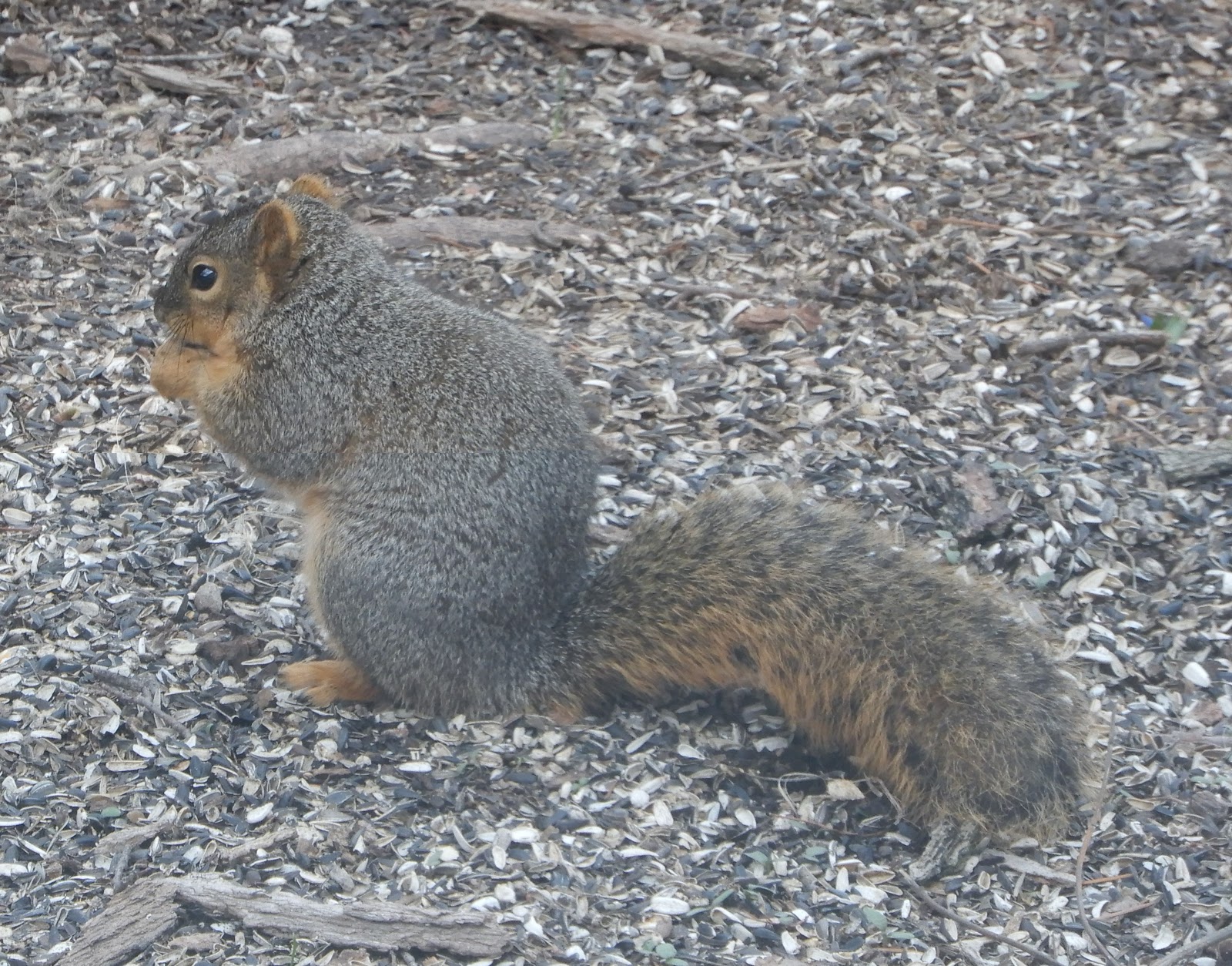
Black wildlife

Different names means they are different. Take a look.

While walking through our gardens, the F1 asked a good botanical question. Is that just a pale squill or is it something different? The answer is actually it was just a pale squill, but in another part of the gardens there is another species that looks superficially like a pale squill. Here they are together. The pale squill looks just like regular squill except it is a nearly white pale blue. What you see here is Scilla siberica (left) and Pushkinia scilloides (right). The flower sizes are similar especially when newly opened, and the coloring along the midvein of the showy perianth (petals) parts is darker.
The squill perianth opens more widely. The Pushkinia stays more bell shaped. Flipping them over shows a lot more differences. The squill has longer stamen filaments and blue anthers, and usually only 1 or 2 flowers per stalk. The Pushkinia has shorter, flattened filaments fused into a column with yellow anthers on the inner surface surrounding a smaller pistil, and usually more than 2 flowers per stalk. Now to make matters slightly more complicated, your lawn might also have (TPP doesn't, but his previous lawn did.) Chionodoxa, glory of the snow, concurrently flowering as well. Its flowers are also blue, but tend to be slightly bigger, to face more upwards, and to have lighter-colored centers. Both can naturalize and spread across your lawn.

Subscribe to:
Posts (Atom)