Field of Science
-
-
Change of address1 year ago in Variety of Life
-
Change of address1 year ago in Catalogue of Organisms
-
-
Earth Day: Pogo and our responsibility1 year ago in Doc Madhattan


Italian bread with no salt - an update

The question of why Italian bread has no salt has raised two hypotheses and here are some of the ideas about this from the local natives, Italians themselves. First, they all agreed on exactly one thing; no salt in the bread is a Tuscan thing. Further south and further north in Italy the bread has salt. So it's only Tuscan bread that tastes bland. Who knew? The favored hypothesis is that Tuscan cured meats, their ham and their favorite salamis are pretty salty, so you just don't need salt in the bread too. The historic hypothesis says that during its many wars with other city states, coastal dwellers sought to punish/subdue Florence by withholding salt. Florence responded by basically saying "We don't need your stinking salt; we'll make our bread without it." But this is a mighty long time keep punishing yourself out of regional pride. These explanations are not incompatible except if you have no salt for bread you also have no salt for curing meat. The things you learn when you travel.
Friday Fabulous Flowers - Italian Renaissance Edition

Who is a botanist?
The Phytophactor is a botanist. His official title is Professor of Botany Emeritus, his graduate degrees are in botany, and the courses he taught were botany courses. Too many of my colleagues think botany is an old fashioned label rather than one of great distinction. Plant science is a favored label of some, but plant science, plant science, plant science, it just doesn't have a ring to it. The problem is that some of my colleagues prefer a narrower perspective. TPP introduced one of his colleagues as a botanist, and my colleague insisted he was not a botanist, so TPP focused things a bit, and said, well, alright Dave here is a geneticist thinking that would mollify him, but again he insisted this was not correct, so fine Dave, you are a cytogeneticist, and then he nodded, stuck out his hand, and said, "I'm a maize cytogeneticist". Now given the importance of maize, this is not a small field, but not recognizing that you belong to larger and more general collective groups is in TPP's opinion, a small perspective. My ecological colleagues prefer to be called an ecologist rather than a botanist, but obviously they are both. And phycologists, physiologists, bryologists, and others all prefer the smaller, narrower label, as if somehow the broader label diminishes their expertise. The Phytophactor is a pure botanist trained in plant anatomy, plant morphology, and systematics/taxonomy, pure, undistilled, unadulterated botany. And it's time botanists of all flavors reclaimed the distinguished field of botany, the study of plants, not plant science, as their own. There. Said and done. And TPP could not be prouder.
Slay the syllabus!
Now that TPP’s academic alter ego has retired is it time for
TPP to stop pointing out the absurdities of higher education? Nah! Nada! Not a chance! So how nice is this
that a columnist at Slate has taken a major swing at that evil monster – the syllabus.
Yes, these days a syllabus is treated by many students and virtually all
administrators, both being just about equally distant from any real vision of education, as a
contract, and TPP totally agrees that this is a sign of the end times for higher education. The problem arises when a student wants to know exactly, precisely, right down to the last twiddle, what they must do in your course to get an A so that they can minimize learning and effort while maximizing their GPA, and your syllabus is supposed to spell this out. TPP actually included a small phrase at the end of one syllabus saying, “This
syllabus is not a legal document and not a binding contract.” Wait, wait, the semester has started and
that’s still Tuscany outside my window! This is disturbing my wa, my
transcendent serenity! It can be restored only by the anguish this blog causes my teaching colleagues.
Botanical Geek Tour - Italian edition continues

 Our Italian Botanical Geek Tour continues with a changing
cast of characters, some not so garden oriented, so the Phactors soldiered on
to visit the Giardino Boboli and Giardino Bardini, which are right next to each
other, almost. Both gardens are of the
formal nature, and in places both provide panoramic views of Florence,
especially Bardini. Giardino Boboli is
the formal gardens behind the Palazzo Pitti.
From the Palazzo entry, the Boboli is all up, and fairly steep; it has a
amphitheater and quite a bit of statuary, but botanically it’s pretty
dull. At the top the garden ends sort of
surrounding the Belvedere Fortress, and if you walk around the fort, and down
just a bit, there is the entrance to the Bardini. It’s also steep and mostly up
hill having been an agricultural area just inside the old city walls where the
steep terrain probably saved it from development. Some areas are still terraced
orchards whose trees are espaliered onto stout fences. A slanted pergola walk is
covered by some big old wisterias. Other gardens and lawns have spring
flowering shrubs, so a bit quiet in August. The views of the city are quite
nice, and it was a clear, not too hot day; no city haze! At the very top is a
coffee shop for a bit of rest and fortification. The image is a formal part of
the Giardino Bardini, looking up the main stair case. The exercise was needed
to make room for gelato (peanut butter and an outstanding passion fruit). Florence as seen from the coffee shop at the top of all those stairs.
Classic Italian botany

Friday Fabulous Fern - A botanical resurrection

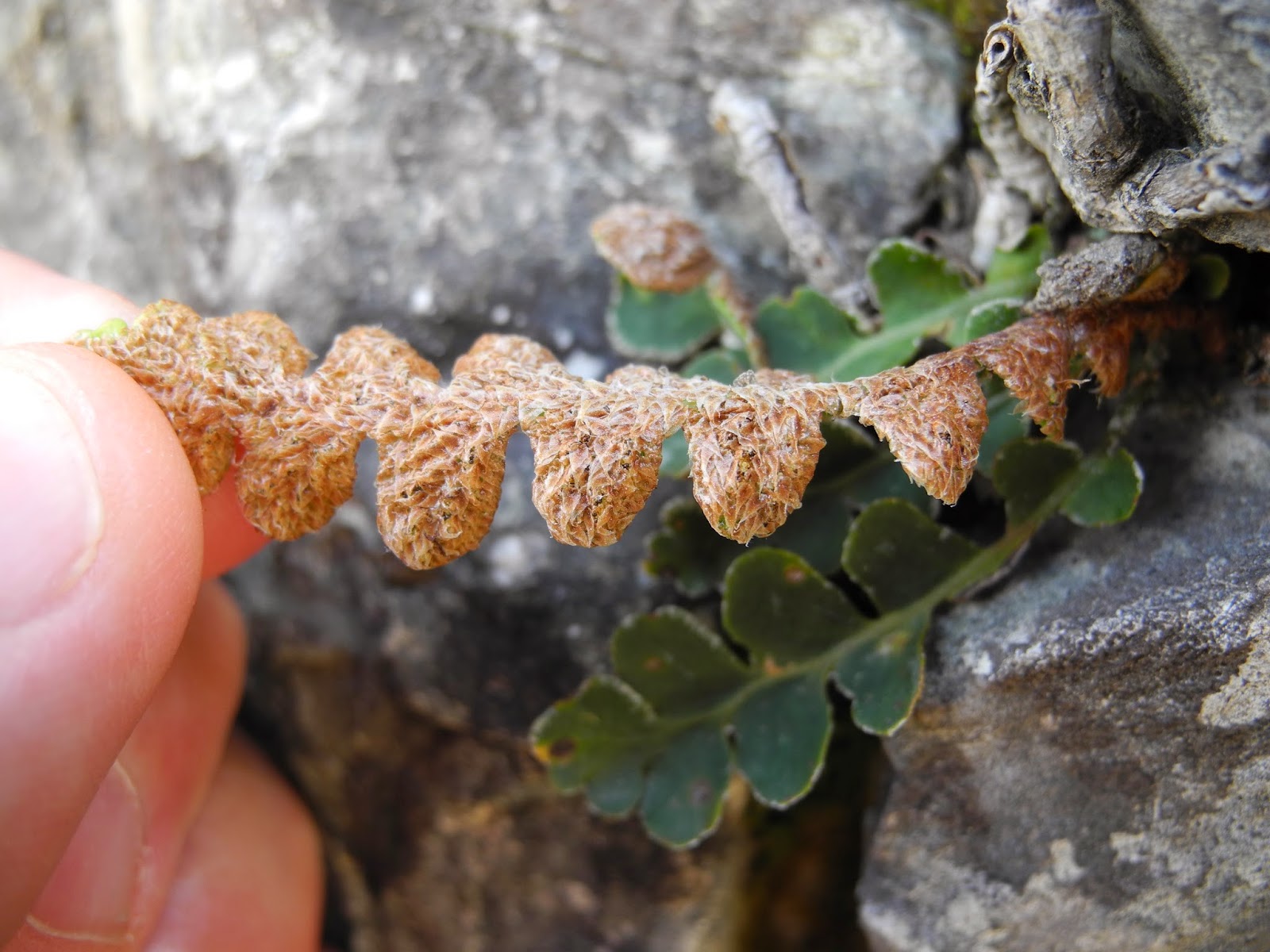 Any tourist to Florence Italy will get their
fill of resurrection because of the abundance of religious-themed art. But there’s another kind of resurrection that
is very common in these parts; so called “resurrection” plants or desiccation tolerant plants. Many ferns,
clubmosses, mosses, and leafy liverworts are capable of desiccation and rehydration, sometimes quite rapidly. In this part of Tuscany,
the agricultural and urban landscape is composed of wall after wall after wall
of mostly rough limestone blocks. There’s a lot of surface area there for tough
plants who can hang onto the wall by rooting into
the cracks and crevasses between or in the rocks. Such environments are pretty harsh, very
hot and dry, intermittently hospitable after rains or during a rainy season.
Quite a number of these desiccation tolerant plants can be found on the walls
of this estate. The primary fern is
Asplenium ceterach, the rusty-backed fern, so called because the backs of the
leaves are covered with brown, scaly hairs that hide the sori. As the fern
dries out the pinnae (leaflets) and fronds curl such that the brown back side of the
leaves is exposed, and the fronds curl almost into a reverse fiddlehead. The hairiness
helps reduce water loss, perhaps reflects sunlight, and may speed rehydration by
trapping water in capillary spaces. When dehydrated these ferns seem like real crispy critters. Right now a little demonstration is
underway to see how fast some of these desiccated ferns can rehydrate. As expected some of the mosses are very fast
at this indeed. But within minutes the fronds begin to uncurl. 12 hours later the fern was rehydrated looking green and fresh. The non-botanists were quite impressed partly because the transformation is so striking, and partly because people have this idea that ferns are delicate little things.
Fiat - now and days of yore

Death by Vespa
The most dangerous thing in Italy other than the narrow mountain roads enclosed by rocky walls are Vespas. There are two ways to die by Vespa, at least as TPP sees it. Death of the first kind deals strictly with Vespa drivers who dart in and out of traffic, even if the bother to throw out a hand signal before cutting into your lane, or cutting between buses and trucks at the rare stop sign, or zipping to the front of traffic lines. Even with reasonable vigilance TPP has almost creamed a couple of them, and he dreads returning the rental car with a new hood ornament. While mildly troubling, risky behavior is a person's own business and if this is you chosen method of offing yourself, by all means be TPPs guest so long as he remains uninvolved. Second, and this is rather the scarier, is when you get caught midway across a street, or alley, by a flock of Vespas charging down upon you with the intent to kill. While individually they are not large, in coordinated pedestrian-hunting flocks they can be quite intimidating with their powder-blue alpha Vespa piloted by a sunglass and scarf wearing, flashily-dressed blond (?) matron of indeterminate age in high heels. Yes, this will produce quite an adrenaline rush as you sprint for the relative safety of a bus lane. So beware you drivers and walkers; the Vespas are stalking you.
In vino veritas

Subscribe to:
Posts (Atom)