Field of Science
-
-
Change of address1 year ago in Variety of Life
-
Change of address1 year ago in Catalogue of Organisms
-
-
Earth Day: Pogo and our responsibility1 year ago in Doc Madhattan


Showing posts with label rainforest. Show all posts
Showing posts with label rainforest. Show all posts
Tropical field trip

The Phactors are off on a tropical field trip having pretty much gotten the gardens put to bed for the winter. It has been 3 or so years since TPP's last visit to the tropics, so this is just more or less a natural history vacay whilst my colleagues teach rain forest ecology to a class of students. Nothing makes retirement seem better than watching someone else working hard to do what you used to do. It does make you empathetic to both parties, but someone has to drink that 2nd cup of good Costa Rica coffee. Of course TPP will be called upon for his plant expertise because this is another area where no one at our institution has any similar knowledge. It is too bad Vulcan mind-melds don't work; you can only acquire this knowledge the hard way by learning it yourself, although it does help to have a mentor showing you things. One hopes that students are curious enough to explore; TPP has learned a lot by just messing with things found along the way, non-vertebrate, non-stingy, non-bitey things, and even then you get surprised by things like nettles and anacards (sumac family). Weather forecast is simple: warm, wet. Regular storms are expected this time of year, but the weather looks like the real wet season. You expect some rain in the rain forest, but too much rain keeps the students from seeing and doing a lot of things. The worst weather TPP ever saw at this part of Costa Rica was our course record of 444 mm of rain in 8 days which is about 18 inches. Gush. You want to hear it, see it? Here's a very brief clip (Costa Rican Sunshine) from an early digital camera in the late evening ("first thing you need to know about rainforest"). Hopefully a few posts from the rain forest will be possible.
Biodiversity in the maize and soybean desert
TPP has long joked about living in the maize and soybean desert of the upper midwest. Sadly this does a grave injustice to deserts because even the harshest desert has more biodiversity than our agricultural fields. 200 years ago this was tall grass prairie which has a surprising and substantial biodiversity and this same grassland community built some of the richest soil in the world. Here in Lincolnland the tall grass prairie is all but gone, less than 1% remains, and it was largely displaced by maize, and later soybeans. In a photoessay of the world's biodiversity, David Liittschwager would document all the biodiversity in a one-cubic foot volume found in a day. In a Costa Rican rain forest, 150 different species were found in his one-cubic-foot placed in the canopy of a strangler fig tree. And all over the world he found surprising biodiversity, and it's mostly surprising because humans pay very little attention to the little organisms. But in a maize field here in north central Lincolnland he got quite a different surprise. Sadly, he found nothing, nothing but maize. In our zeal, in our passion, in our desire for maize, our agricultural methods have come as close as possible to creating a complete monoculture. It's no wonder that more wildlife lives in our cities and towns than outside the city limits because out there it's a biological wasteland, except for crops. This represents nature bent entirely to human will, and again because little attention is paid to this, it's been estimated based on measurements here and there, that half of this marvelous prairie soil is gone, and so is the community that made it. So how smart are humans anyways? Do you need a crystal ball to see what the future may bring?
Rainforest understory
Rainforest is hard to describe, hard to show to anyone who
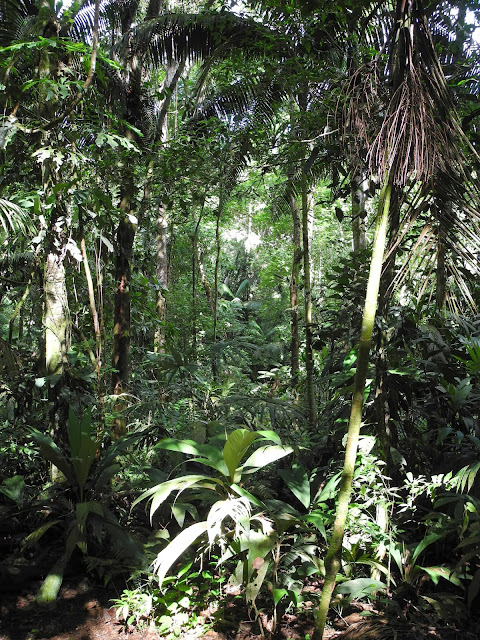 has not experienced it first hand. Of course, that is why TPP is here to give his students that experience. Here and there in the forest are views that give you some sense of what the forest is like, but they are somewhat hard to find and very hard to photograph. And long time readers might remember that TPP has tried (sorry no links, the search function isn't working). Rainforests are layered: herbs and ferns, shrubs & palms, understory trees and larger palms, subcanopy trees and palms, canopy trees, and emergent trees. Vines, lianas, lace themselves through all of this. All in all this presents a wall of vegetation where the tallest trees reach 50 meters. So here's this years attempt at photographing the rainforest understory with some real depth of field. Tell me what you think.

Rainforest field trip - not this year
 Sixteen years ago TPP initiated a rainforest ecology class with a field trip which is now taken over the 9-day long Thanksgiving break plus a day or two. Owing in part to its popularity, and in part to wishing to be around for holidays with family, every now and then, a rotation of instructors means that now TPP only teaches "his" course two out of every four years. It was a wonderful weekend in Lincolnland to mostly finish up fall yard work and begin helping Mrs. Phactor with holiday decorations. But as beautiful as it was TPP found himself wanting to take a walk through the rainforest, not necessarily teach the class, but just to soak in the sounds, smells, and sights that are rainforest. It's just such an endlessly fascinating place, and having spent so much time there, the things that put off many people just go unnoticed, but these days the majority of people are not actually comfortable out in nature so accustomed they are to totally tame human environs. A few emails have arrived from students to tell TPP what a great time they are having, or what wonderful thing they've seen, or that it's been raining. A colleague reports that a study tree of our interest has stiffed us once again by not flowering when one of us is there. One of the best things we do is provide such experiences for our students, even though it represents a considerable undertaking for the faculty involved. Foreign travel with college students remains fraught with real and potential problems, logistical nightmares, but when you put students in a stimulating environment you find that it becomes very easy to teach. The image is from an area in the middle of a long-time study site that has an improved trail for quicker access.
Rainforest in the rain
 Rainforest always looks its best just after a rain or during a light rain; in a real heavy rain you just can't see anything. Took our traveling companions of a field trip to see some rain forest in a light rain. This particular forest was in a national park at about 900 m above sea level. Here's a nice picture of the forest profile, a particularly difficult type of picture to get because you are seldom in the right place to see the forest like this. The primary vine in this forest is rattan palm, not one of the Phactor's favorite plants as it is forever trying to rip your head off. In just showing people the darned thing it ended up planting some of its grappling hooks in my hand. It's why the locals call it "lawyer cane" because once it gets its hooks into you it never lets go. Our temperate forests have fewer layers and are deciduous. Next blog another nasty denizen will be introduced.
Rainforest Field Trip - Oh, Toto, we aren't in Lincolnland anymore.
 One of the great joys and best reasons for organizing an overseas field trip, not to be confused with a tours, a tour group, and a tour guide, is the surprise, awe, joy, and excitement of students when first they encounter the rain forest. Everywhere they look is something new and interesting, and simply the things observed during a 3.5 hour hike with a Costa Rican naturalist would fill this blog for several weeks. So today is a day they will remember for a good long time, and the Phactor is quite happy that he is in no small way responsible for providing this experience. Providing such educational opportunities is after all my job. Here are some students from Lincolnland trying to decide if this is any different from being afield in the maize and soybean desert. As this picture was being taken a flock of oropendula flew over and they got to hear their unmistakable gargling call. However the effects of the short night and the sudden switch to heat and humidity, and hiking in tall rubber boots, has taken its toll and they will be a quiet bunch tonight, mostly.
Field trip winding up (down)?
 Well, it's happened again, what with all the natural history, all the biological diversity, all the talk of experiments and data, all the cool observations and encounters, early morning or late nights in the rain forest, and kilometers of hiking, another fine field trip is shot to heck.
 This year's class have been about as good as a group of biology majors gets, and the Phactor has not acquired any new gray hairs from their behavior. He is worn out simply because when you're on educational call more or less around the clock, there is not enough (2 instructors, 18 students) to go around.
So here's one more bit of rainforest natural history. Late November is near the end of the rainy season, and it's been wet, oh not anywhere near a record year (over 470 mm rain in 10 days), but sufficiently wet to keep the amphibians active and happy. One of the neatest little fellows is the levi frog (Dendrobates) so called because of their blue legs. Most of the frogs with which you are familiar are cryptically colored, but these stand out vividly. And their call is very loud, especially for their size (less than 2 cm long), sort of inviting you to find them. But this is a poison arrow frog, and the coloring is there to train any potential predators that this froggy will make you as sick as a dog. This is an example of aposomatic coloring where organisms use bright and vivid patterns to advertise their distastefulness. This one has actually just deposited a tadpole that they were carrying on their back into a little pond of water in a tank bromeliad.
Now to pack and return to early winter, the end of the semeser, and finals in Lincolnland. Blah!
Little ants bring big rainforest down to size
Rain forest is one great place for viewing interesting biological interactions. And one little thing about the tropics is pretty easy to remember, ants are everywhere. This field station is home to over 500 species according to the experts. But without question one of the most prominent and common of these are the leaf cutter ants (Atta). Leaf cutter ants do not eat leaves, although in their millions they are one of the biggest "herbivores" in the rain forest. Piece by piece they carry the canopy back into their subterranean nest to cultivate a very specific fungus, which reciprocates being so well cared for and fed by providing the ants with food. And so you do not have to walk very far to view the highly amusing parades of workers carrying pieces of tree leaves to their nest. Out bound workers rush by to get more leaf pieces. Larger ants are soldiers protecting the workers, and if you watch closely you'll see "riders", somewhat smaller ants riding along on many of the leaf pieces. This peculiar behavior functions to protect the riders from parasitic flies who seek to lay eggs on workers returning to the nest.
Drink of the gods

This is a pretty interesting rain forest flower for several reasons. One it's sort of hard to figure out what parts is what; two, the flowers appear right out of the trunk of the tree; three its generic name, Theobroma, means "drink of the gods"; and four, the common name of the most famous product from this genus is Mayan for bitter water. This is a wild species, but the cultivated species is also called cacao, the source of chocolate, or "chocolatl" (bitter water). And a spicy, fatty version of hot chocolate was the royal beverage of Aztecs. In the evergreen tropics many trees produce flowers on "old wood", their limbs and trunks where the leaves don't obscure the flowers, a phenomenon called cauliflory. Back up in Lincolnland red bud is one of the few temperate trees that do this. Red pods will follow. The mature seeds are the source of chocolate.

On other fronts the students are proving to be a great lot this year, very interested and very industrious. It has been wet, raining every night, and showers almost every day. However nothing like last year's forest-field station flooding deluge. Woke up this AM to the gargling call of oropendolas.
Rainforest reality might be dangerous
The Phactor is as familiar with and as comfortable in the rainforests of Costa Rica as anyone in Lincolnland. So learning that the former 1st lady of Lincolnland was “in reality camping out” in those same rainforests fills me with concern. She’s a city person, and a great many dangerous organisms live in those rainforests, more snakes, especially very well camouflaged pit vipers, live there than any place I’ve ever visited, and I’ve visited many. The 1 inch long black bullet ant (seen here) is reputed to have the most painful sting of any stinging insect, and those unfortunate enough to have experienced it leave me convinced. There are lots of thorny, spiny plants too. Stilt palms seem specifically designed to trip you and mangle your falling flesh. Both puma and jaguar prowl the depths of the rainforest (their tracks tell of their presence), and that may be why the peccaries, when startled, let loose a cloud of skunk-like odor that brings tears to your eyes. And before you jump in a stream to wash off that smell, do look out for crocs.
 Stilt palms seem specifically designed to trip you and mangle your falling flesh. Both puma and jaguar prowl the depths of the rainforest (their tracks tell of their presence), and that may be why the peccaries, when startled, let loose a cloud of skunk-like odor that brings tears to your eyes. And before you jump in a stream to wash off that smell, do look out for crocs.
However the source of my great trepidation is that all these innocent creatures have no adaptations for dealing with the lying, cheating, back-stabbing, name-calling, back-room-deal-making, pay-to-play, corrupt politicians of Lincolnland, or their equally conniving spouses.
Subscribe to:
Posts (Atom)