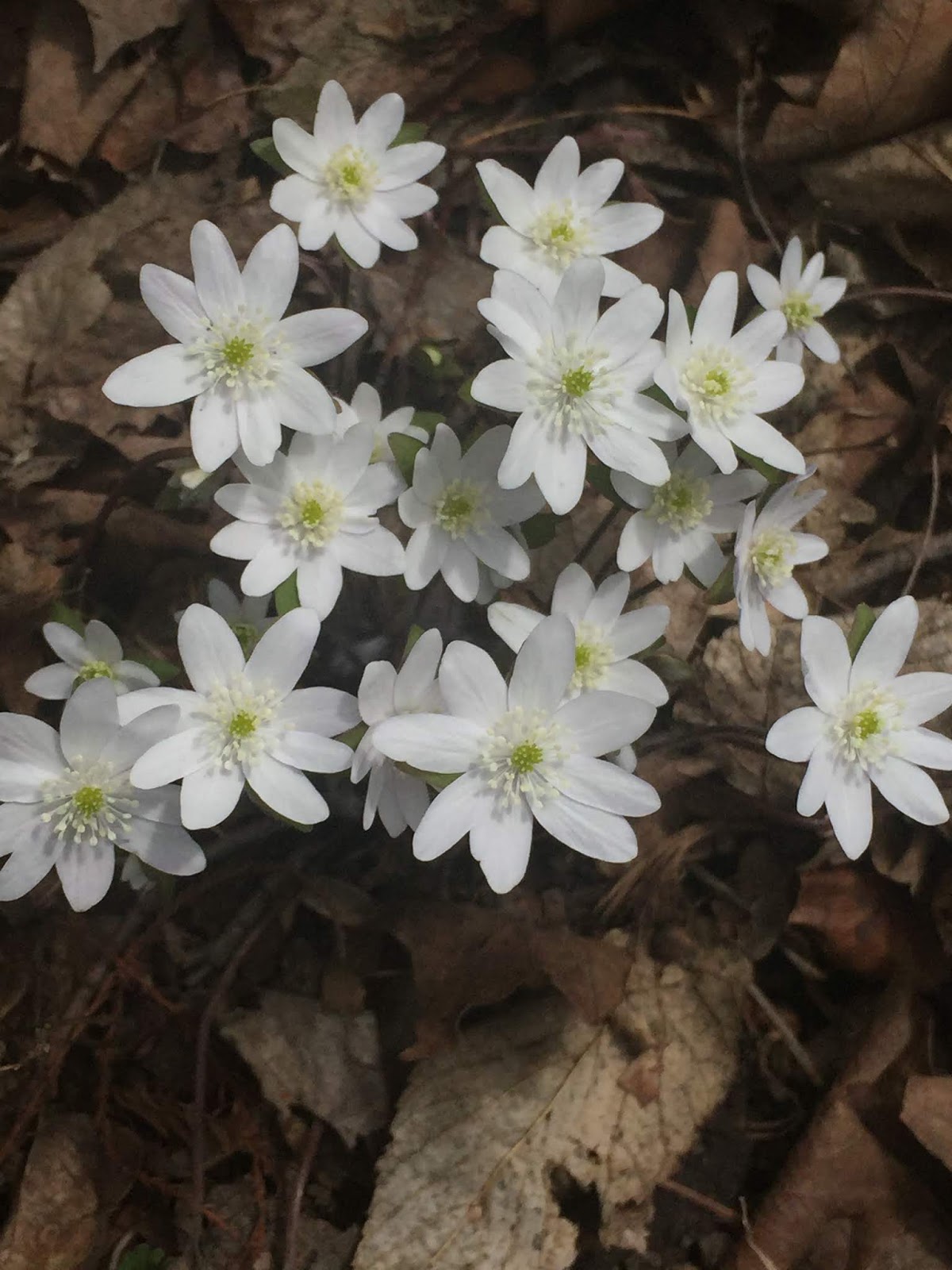
Lots of familiar spring flowers are getting their names changed, and sometimes it is very annoying. And this is one of those cases and it's not just because TPP's brain has been using some of these names for over 50 years and doesn't change gears as fast as it used to. One of our earliest of woodland ephemeral perennials is called "liverleaf" because last year's persistent leaves have turned a dark, purple-brown (a color not unlike that of a liver) and they are 3-lobed (like a liver). To the herbalist this was a sign that this plant could be used for liver ailments (probably not), but the name sort of said it all. Now de Candolle certainly knew this when he named the plant Hepatica.
Generally this plant grows on slopes in woodlands. A member of the buttercup family, the flowers have a variable number of petals like part in a range of say 6-9, with three bracts beneath. Their color is often white, but they can range to pink and purple. In out gardens they seem to like be tucked away in little places between the roots of big trees. The plants tend to be maybe 6-7" across. Ours took quite some time and repeated starts to get established and now the reward is finding a seedling every now and again. The first image shows the purplish color form (a seedling) and the second a mature plant in full bloom.
Some people have shifted this species to the genus Anemone. Some people don't think H. acutiloba is not a distinct species. And TPP wishes everyone could make up their minds. But for now it will remain Hepatica in TPP's memory database.
- Home
- Angry by Choice
- Catalogue of Organisms
- Chinleana
- Doc Madhattan
- Games with Words
- Genomics, Medicine, and Pseudoscience
- History of Geology
- Moss Plants and More
- Pleiotropy
- Plektix
- RRResearch
- Skeptic Wonder
- The Culture of Chemistry
- The Curious Wavefunction
- The Phytophactor
- The View from a Microbiologist
- Variety of Life
Field of Science
-
-
Change of address1 year ago in Variety of Life
-
Change of address1 year ago in Catalogue of Organisms
-
-
Earth Day: Pogo and our responsibility1 year ago in Doc Madhattan
-
What I Read 20241 year ago in Angry by Choice
-
I've moved to Substack. Come join me there.1 year ago in Genomics, Medicine, and Pseudoscience
-
-
-
-
Histological Evidence of Trauma in Dicynodont Tusks7 years ago in Chinleana
-
Posted: July 21, 2018 at 03:03PM8 years ago in Field Notes
-
Why doesn't all the GTA get taken up?8 years ago in RRResearch
-
-
Harnessing innate immunity to cure HIV10 years ago in Rule of 6ix
-
-
-
-
-
-
post doc job opportunity on ribosome biochemistry!11 years ago in Protein Evolution and Other Musings
-
Blogging Microbes- Communicating Microbiology to Netizens12 years ago in Memoirs of a Defective Brain
-
Re-Blog: June Was 6th Warmest Globally12 years ago in The View from a Microbiologist
-
-
-
The Lure of the Obscure? Guest Post by Frank Stahl14 years ago in Sex, Genes & Evolution
-
-
Lab Rat Moving House15 years ago in Life of a Lab Rat
-
Goodbye FoS, thanks for all the laughs15 years ago in Disease Prone
-
-
Slideshow of NASA's Stardust-NExT Mission Comet Tempel 1 Flyby15 years ago in The Large Picture Blog
-
in The Biology Files
A plant pundit comments on plants, the foibles and fun of academic life, and other things of interest.
Showing posts with label liverleaf. Show all posts
Friday Fabulous Flower - wildflowers in gardens
Happy Earth Day! Lots of people ask about using prairie and woodland wild flowers in gardening. They're mostly interested in what and how. In honor of the day some examples will be given. One of the easiest, and a fairly showy spring wildflower other than the weedy bluebells that grow all over our gardens is bellwort (Uvularia grandiflora). They grow in clumps, sometimes dense ones, but they aren't weedy or unruly spreaders, and they are easily divided so they grow here and there around our spring gardens. But the foliage persists and in the fall makes a nice cinnamon brown cluster. The flowers are pendent and have the curiously twisted petals.
Liverleaf (Hepatica acutiloba) is small and a very early wildflower. They are also picky. While a woodland flower they like shady slopes where they don't get covered in leaves. Lacking that ours like being plants at the base of large trees again where they don't get buried. The flowers can vary from white to pale pink to deep pink (rare). Very nice, but for many people a why bother plant. Sorry couldn't find a flower picture.
OK so lastly, one of TPP's favorite garden wildflowers. It isn't showy, it isn't common, it is easy enough once established if you have a nice woodland habitat for it, but only a wild flower fancier will appreciate it: blue cohosh (Caulophyllum thalictroides). It's just nice to know you have it.
The foliage and flowers have that bluish cast, but as can be seen not very showy. It's also kind of neat because the flowers are constructed in multiples of 3s, so that should say to you "monocot", but this is a dicot, a member of the barberry family. So TPP finds that fun too. Many of the tropical magnoliid plants have a similar situation of having 3-parted flowers. This one is surrounded by blue bells that almost hide it from all but the most discerning eyes.
Friday Fabulous Flower - Liverleaf
Walt Disney at Dawson Lake
This poem was written by James McGowan and read at a memorial service in celebration of this life. In a real coincidence, Mrs. Phactor called the poem to my attention today, the day that the second stanza was observed for real by my taxonomy class out in the field (finally). Enjoy it. Jim did.
He's grab his sketch book
go in April, May
for the Spring flowers--
to make them characters,
his little men and women, boys and girls.
He'll do a film
where they all sing and dance around--
but he must catch them first:
There's Hepatica,
she's trying on dresses,
white to pink to blue, deep purple.
O that giddy girl look good in every one.
Spring Beauty laughs; she's everywhere
she owns the uplands, sings soprano
she'll be the chorus
(alto Blue Bell answers from the creek,
Wild Ginger, red-faced, croaks the bass).
Jack-in-the-Pulpit needs to loosen up.
Walt's going to match him with
that ditzy blond, the Bellwort.
There with the druggy Toothwort
they'll cavort.
Some extras: White Trout Lily as a pious bride,
her yellow sis a freckled tomboy farmer's daughter.
Blue-eyed Mary is a peppy prep,
cheer-leader through and through.
That Dutchman's breeches is a bumpkin oaf,
comic relief,
Squirrel Corn his steadier brother (lots of heart).
A plot? Who knows. Old Walt will work it out--
a new Fantasia of Spring
Set in that wholesome heartland,
Illinois.
So here's Hepatica acutiloba in one of her rarer dresses; around here the dress color is usually white to very pale pink. And this year it's too early for any of the other "characters" to have flowered.
Subscribe to:
Posts (Atom)