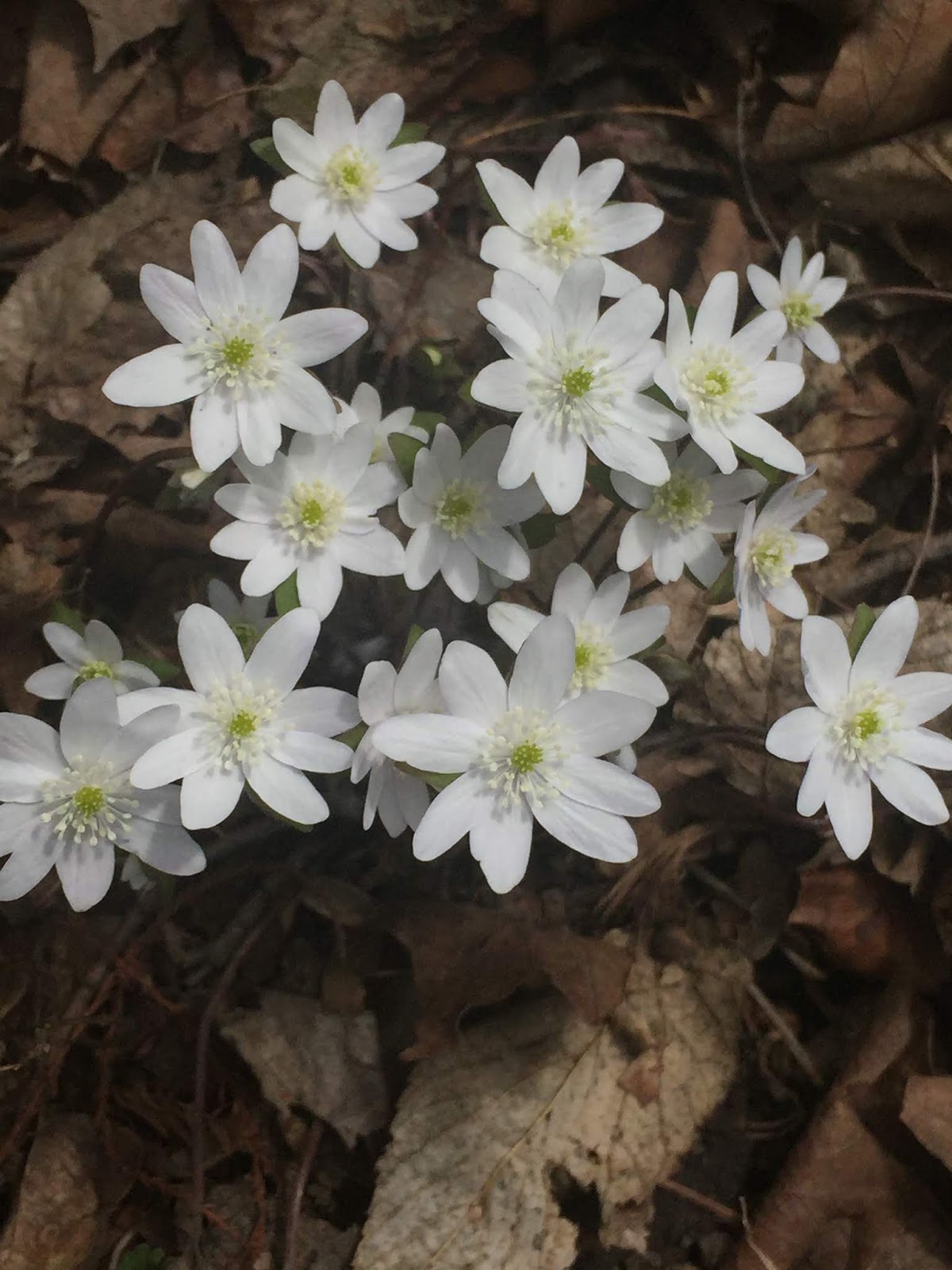
Lots of familiar spring flowers are getting their names changed, and sometimes it is very annoying. And this is one of those cases and it's not just because TPP's brain has been using some of these names for over 50 years and doesn't change gears as fast as it used to. One of our earliest of woodland ephemeral perennials is called "liverleaf" because last year's persistent leaves have turned a dark, purple-brown (a color not unlike that of a liver) and they are 3-lobed (like a liver). To the herbalist this was a sign that this plant could be used for liver ailments (probably not), but the name sort of said it all. Now de Candolle certainly knew this when he named the plant Hepatica.
Generally this plant grows on slopes in woodlands. A member of the buttercup family, the flowers have a variable number of petals like part in a range of say 6-9, with three bracts beneath. Their color is often white, but they can range to pink and purple. In out gardens they seem to like be tucked away in little places between the roots of big trees. The plants tend to be maybe 6-7" across. Ours took quite some time and repeated starts to get established and now the reward is finding a seedling every now and again. The first image shows the purplish color form (a seedling) and the second a mature plant in full bloom.
Some people have shifted this species to the genus Anemone. Some people don't think H. acutiloba is not a distinct species. And TPP wishes everyone could make up their minds. But for now it will remain Hepatica in TPP's memory database.
- Home
- Angry by Choice
- Catalogue of Organisms
- Chinleana
- Doc Madhattan
- Games with Words
- Genomics, Medicine, and Pseudoscience
- History of Geology
- Moss Plants and More
- Pleiotropy
- Plektix
- RRResearch
- Skeptic Wonder
- The Culture of Chemistry
- The Curious Wavefunction
- The Phytophactor
- The View from a Microbiologist
- Variety of Life
Field of Science
-
-
Change of address1 year ago in Variety of Life
-
Change of address1 year ago in Catalogue of Organisms
-
-
Earth Day: Pogo and our responsibility1 year ago in Doc Madhattan
-
What I Read 20241 year ago in Angry by Choice
-
I've moved to Substack. Come join me there.1 year ago in Genomics, Medicine, and Pseudoscience
-
-
-
-
Histological Evidence of Trauma in Dicynodont Tusks7 years ago in Chinleana
-
Posted: July 21, 2018 at 03:03PM8 years ago in Field Notes
-
Why doesn't all the GTA get taken up?8 years ago in RRResearch
-
-
Harnessing innate immunity to cure HIV10 years ago in Rule of 6ix
-
-
-
-
-
-
post doc job opportunity on ribosome biochemistry!11 years ago in Protein Evolution and Other Musings
-
Blogging Microbes- Communicating Microbiology to Netizens11 years ago in Memoirs of a Defective Brain
-
Re-Blog: June Was 6th Warmest Globally12 years ago in The View from a Microbiologist
-
-
-
The Lure of the Obscure? Guest Post by Frank Stahl14 years ago in Sex, Genes & Evolution
-
-
Lab Rat Moving House14 years ago in Life of a Lab Rat
-
Goodbye FoS, thanks for all the laughs15 years ago in Disease Prone
-
-
Slideshow of NASA's Stardust-NExT Mission Comet Tempel 1 Flyby15 years ago in The Large Picture Blog
-
in The Biology Files
A plant pundit comments on plants, the foibles and fun of academic life, and other things of interest.
Showing posts with label buttercup family. Show all posts
Friday fabulous flower - yellow lawn edition
This isn't the first time TPP has blogged about this neighborhood side lawn, but it's just so damned cheerful to see this early every spring. The Phactors have long had blue lawns (see links on above page) and the first harbingers of blue are poking up here and there before the entire lawn turns blue, but this hedgerow of yellow (Eranthis hyemalis - Winter aconite, buttercup family) has been here for more than half a century showing that if you just don't disturb things, plants can do well. This little bulb (corm) is a bit hard to get going sometimes, and while the tree rats don't eat them, they do dig them up when newly planted. And then they flower, fruit, and disperse their seed until eventually you have a bed of early spring golden-yellow.
Friday Fabulous Flower - Black snake root
Black snake root (Actea (formerly Cimicifuga) simplex) is a great shade-loving, fall flowering plant. The bright white bottle brush inflorescences standing up 3-4' tall are quite striking in shady borders that don't have much else going on this time of year. Another member of the buttercup family, you don't have to worry about them getting nibbled on. The showiness of the flowers is primarily the function of the stamen filaments with a little bit of help from some petal like bracts. The flowers are very fragrant in a sweetish, musky, pheromone sort of fashion attracting quite an array of insects so no idea which are effective pollinators. Many new varieties exist with bronze to purple vegetation of much dissected leaves. These are terrific plants for shady border areas.
Native plant sort of
TPP is not a native plant purist because he is also a compulsive plant collector. Hey, everything is native somewhere. However in a rather gray area are cultivars of native plants where the species is native, but cultivars exist. Generally these grow fine because the basic genome is adapted to your area. Here's one of these problematic plants that is a quite handsome spring woodland ephemeral, rue anemone (Thalictrum thalictroides formerly Anemonella thalictroides - buttercup family)(Yes, another taxonomic change that is messing with 40+ years of memory). The cultivar has pinky-purple foliage more or less retaining a juvenile character because young shoots are more pigmented than the mature foliage. The cultivar also has some pigmentation in the flowers, which are more or less white in the wild. And the flower is doubled, so stamens develop as petalloid sepals. In the wild the flowers can have 5-10 petalloid sepals (It always bothered students when the number was 6 and they head the wrong way in the ID key) and the color is variable with naturally occurring pinky flowers not uncommon, but never seen a wild one doubled. However this is not an unusual type of developmental aberration in the buttercup family. How can you not like this little plant? It's cute. Those flowers are not quite an inch in diameter and as you can determine both from the date and the leaf litter, they flower early.
Friday Fabulous "Flower" - Winter aconite
Friday Fabulous Flower - Japanese Anemone
Friday Fabulous Flower - Wolfsbane
Subscribe to:
Posts (Atom)