Field of Science
-
-
Change of address1 year ago in Variety of Life
-
Change of address1 year ago in Catalogue of Organisms
-
-
Earth Day: Pogo and our responsibility1 year ago in Doc Madhattan


The thought crime of global warming

"Florida Minitrue is taking doubleplusuncold for crimethinking words "climate change,” "global warming”, "sea-level rise" or "sutainability." The Governor, Rick Scott, says he "was not a scientist" which is plustrue. Is a doubleplusgood example of Doublethink, described in 1984 by Winston Smith." Who can argue with that? How else should policy be constructed? How else do you decide on appropriate action? The GOP strategy for dealing with climate change is to define it out of existence. Goodbye Florida, glug, glug.
Color of spring
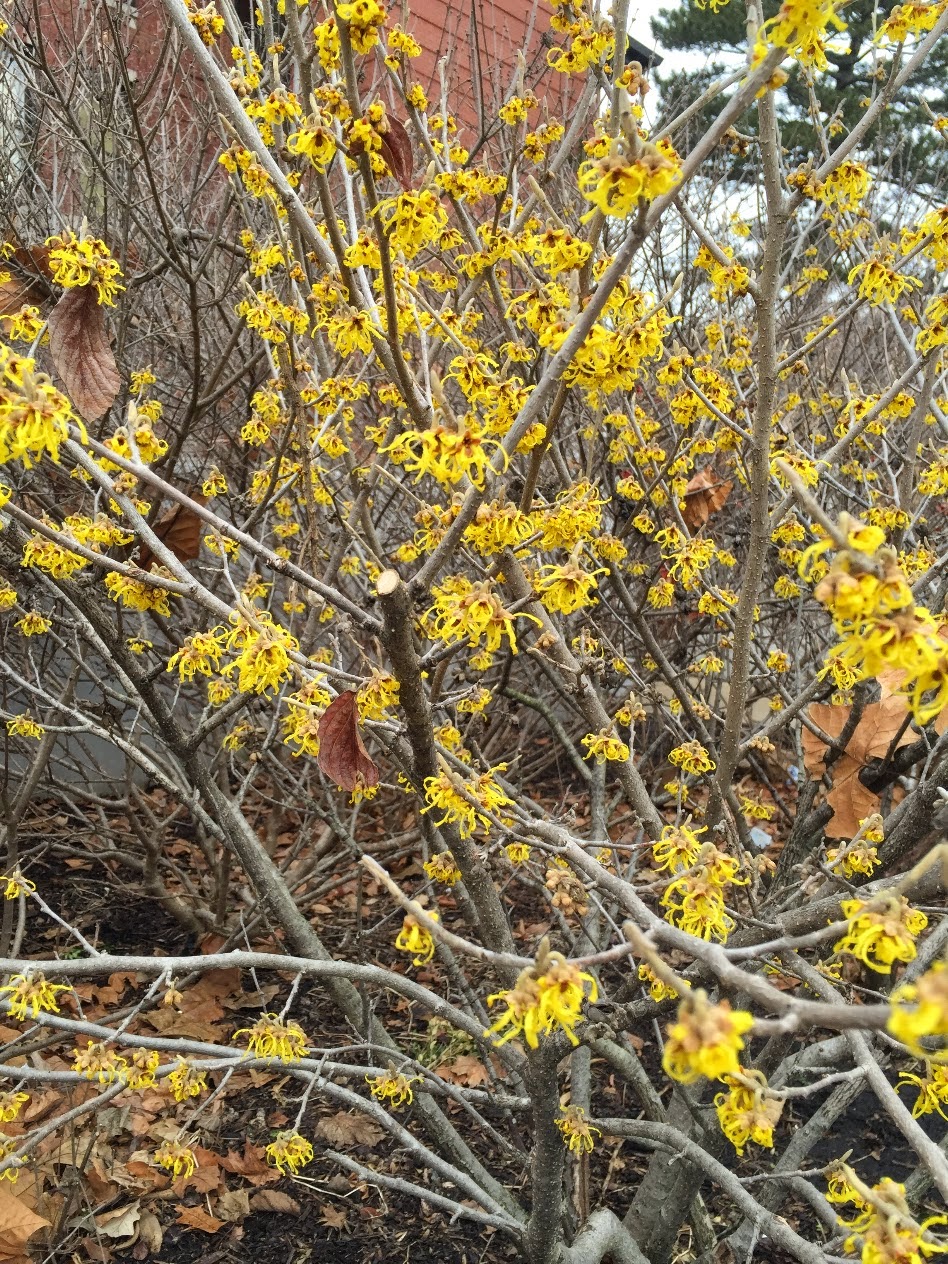
Spring!!
Yes, TPP declares spring is officially here in the upper midwest. No, it's not because of daylight savings time, which for goofy reasons is controversial this year here in Lincolnland. Apparently a one hour change in the lives of today's average citizen is an intolerable adjustment. No flying to the west coast for you guys! Personally the Phactors like having more daylight later in the day, but then again we're gardeners. No, it's not because the only thing on TV is basketball; spring can't wait until basketball is over. By then it's nearly the 4th of July. Partly it's because it a downright balmy 50 F outside, and in comparison to the quite cold February, this is downright springy weather. It's because the first flowers are blooming! Yes, a witchhazel wins this years 2st to flower award. Early crocus and snowdrops are not far behind, and the buds of the silver maples are swelling. Our witchhazels are in shady spots, so they are still not ready to flower, but while out on a walk around the hood, some shrubs on the SW corner of a brick wall were in flower. Being a nice guy, TPP stopped by the local garden shoppe and purchased some pansies for some early color. It's always surprising how tough pansies are, and of course, these were forced in a glasshouse, but they are still cheerful. At least 8 fox squirrels are outside busily cleaning up all the birdseed that got buried in the snow, and while well fed, they are looking a bit scruffy, another sign of spring.
Seed germination
Some seed germinate easily; some are hard or tricky to get to germinate because of their dormancy. So why is it that all the species TPP works on are in the 2nd category? Seeds do this for a variety of reasons. If all a plant's seeds germinate readily and something happens to the entire crop, like a late freeze, a generation has been lost. Not so bad for a perennial. However having some seeds that are reluctant to germinate produces a seed bank where not all the seeds produced each season germinate so some remain for the next season. So even if pollination and seed production are terrible, some seedlings may appear from last year's seed. Seeds here in the temperate zone often need a cold period to promote germination, a process called vernalization. Some need alternating cold then warm periods. Some need to have their seed coats etched or softened by a trip through a digestive tract. But then some need to be begged and pleaded with, and still they fail to germinate or germinate a such a low rate as to be useless. What an annoyance! And you often try to imitate natural conditions figuring something out there worked, but there are a lot of variables and it takes considerable time and a lot of fiddling. Part of you wants to solve this problem, this riddle, but so much time has been invested already you just don't want to invest that much more. BTW, seedlings from the field don't like being transplanted either. No wonder so many people work on a stupid little mustard.
Freeze and thaw
The high today was nearly 50 F and it felt like a heat wave. The snow cover melted from most exposed areas revealing an awful lot of lawn and garden work to do. Just picking up the limbs and twigs will take a couple of hours. With daily highs predicted to be above freezing for a week or more, the shift toward spring will being rather suddenly. Better get the cold frame repaired, but finding the right double-walled polycarbonate was not easy. The original material fell apart rather quickly & one explanation was that the polycarbonate for outside use was put in upside down with the UV filter coated side down (it is one-sided). The material used in the cold frame is thinner than what you can find in the big-box home stores, but our nifty local specialty glass place could get TPP an 4 x 8 foot sheet.
On the other hand, the chest freezer needed some repacking and so TPP found himself delving deep into the freezer. You find some surprises, good ones and bad ones. Today the finds were good including nearly a kilo of Costa Rican coffee beans. Yea! Tonight's dinner will be an attempt to finally get rid of the last of a large roast ham that had been lurking in the frozen depths for too long. Someplace there are guidelines for how long things can be kept frozen, but generally, if it can't crawl out of the freezer on its own its probably still safe to eat. Also found some nice Spanish chorizo to use with some of afore mentioned ham to make a paella thereby killing two ancient freezer items in one dish! At times my efficiency boggles the mind.
On the other hand, the chest freezer needed some repacking and so TPP found himself delving deep into the freezer. You find some surprises, good ones and bad ones. Today the finds were good including nearly a kilo of Costa Rican coffee beans. Yea! Tonight's dinner will be an attempt to finally get rid of the last of a large roast ham that had been lurking in the frozen depths for too long. Someplace there are guidelines for how long things can be kept frozen, but generally, if it can't crawl out of the freezer on its own its probably still safe to eat. Also found some nice Spanish chorizo to use with some of afore mentioned ham to make a paella thereby killing two ancient freezer items in one dish! At times my efficiency boggles the mind.
Friday Fabulous Flower - tropical springiness

It's been awhile since there's been a FFF posted. Tropical plants do something sort of strange each year. A lot of them flower in late February or March in the glasshouse, yet most of them are thought to be day-neutral for flowering. This means that they don't need long nights to stimulate flowering, yet that's just how they act. Of course the glasshouse is also warming up a little and getting a lot sunnier. At any rate here's a member of the Bignoniaceae, a family of largely tropical trees, shrubs, and lianas, a family with fairly large, pretty colorful flowers. The trees and shrubs also tend flower in a big-bang of blooms making for some pretty spectacular displays. This shrub is called the Cape Honeysuckle (terrible name that points to the wrong family), Tecomaria capensis, a fairly common ornamental, in fact probably in the category of UTF, ubiquitous tropical flora. But it's just so cheerful, so bright, such a welcome relief from the bitter cold and bleakness outside. You should be able to guess that such flowers are adapted for bird pollination based on the color, the lack of odor (scratch & sniff), and the exserted stamens and stigma. Enjoy!
Sweet Briar College closing
TPP read this news item with a bit of nostalgic sadness. Sweet Briar was called one of the southern seven sisters; a women's college for young ladies of good breeding. This does not mean TPP has any direct connection to Sweet Briar, and everything about it was learned mostly in a two day period 40 years ago on what was one of a young botanist's first job interviews. After giving a presentation at a national meeting, this young PhD (26 at the time) was approached by the Chair of Biology at Sweet Briar and asked if I would like to visit for a job interview. The application had been made a long time before, and you figure it's just a matter of time before you get the thank you very much for applying letter, but not you is our decision. Apparently they liked to get a look at the applicant first. Perhaps you may wonder about the wisdom of a newly minted, 20 something PhD thinking about taking a job at a women's college, and it was a concern, but it was a job. At any rate Sweet Briar was a handsome place although young women in riding habits on horse back was a different sort of scene. As were the pearl necklaces and white gloves of the young women who escorted this bewildered fellow around campus. While many of the students were rich, and entitled, they also had a lot of academic talent if you could get through the southern veneer and get them actively involved in science. Guess they thought the New Yorker attitude & personality might be able to do it, but TPP was a bit more ambitious so other opportunities seemed better. Still it's too bad that such a bastion of the old south, as it seemed, has found itself facing intolerable changes leaving closing up shop as the only viable option rather than fading away in a futile struggle. TPP taught for a semester at one such place, and it was truly a sad thing to witness. Times are being tough on all small, liberal arts colleges as people foolishly denigrate such degrees, and rural women's schools particularly; a lot of them won't survive.
Very cool cargo trike
Just look at this very cool, very innovative, electric-assisted cargo
tricycle. Wow! Who wouldn't want one of these? Perfect for visiting your local farmer's market or running to the neighborhood bakery or wine shoppe. This one is a Raiooo, made in Portugal, and it
involves so many nifty things you would do best to go and read about
over at Treehugger where there are more images too. Innovative bicycles just keep showing up making you think they are a favorite subject for creative engineers and designers. It's probably true but mostly because this trike took a lot less money to design and build than a Tesla. In particular the wooden handle bar and frame pieces are so nifty, as is the front bag. But where is the holder for your coffee cup? Come on! Don't say it's not an option!

Ice is nice (?) and will suffice
TPP's major achievement for today is to have gotten to the safety of his office without breaking a hip. As a nice change of pace in the winter weather, over night the area was treated to a very thin, very slick glazing of ice produced by freezing rain. This first near fall occurred while fetching the morning newspaper from the front steps. It was treacherous out there, and TPP witnessed several sliding cars, a sliding city bus, cars unable to go up even gentle slopes, and people slipping and falling including a fellow wearing a Chi-town Blackhawk hockey jersey. This is rather ironic because TPP's ability to traverse slippery surfaces comes from a misspent youth of hockey playing upon every frozen bit of water that we could find. And thus who is to say that it was time misspent if you develop such skills and can still smile about it with all your own teeth.
Climate expert bought and paid for by fossil fuel companies - not really news
Fossil fuel industry caught taking a page out of the tobacco playbook (link). That's the headline from the March 3, 2015 online version of the Guardian. This refers to people finding out that W. Soon failed to tell people where his money comes from, but this is not really news. This was known, but obviously not widely known, at least 18 years ago. Here’s bit of history from an article (The Wall Street Journal Blurs the Lines Between Science,
Opinion, & Politics on Global Warming, 1998) published in a smallish skeptic newsletter, which demonstrates the principle that work published in obscure journals tends to remain obscure, but bigger publications (e.g., Skeptical Inquirer) said the story was “old news” and not a current event story, so they declined to publish it. Here's the introduction from the 1998 article.
"This affair started March 1998 when I received an unsolicited reprint of a scientific article entitled "Environmental effects of increased atmospheric carbon dioxide," by A. B. Robinson, S. L. Balinus, W. Soon, and Z. W. Robinson. The article was accompanied by two items. The first was a photocopy of a four-column news item from The Wall Street Journal (Dec. 4, 1997, although the date did not appear on the photocopy). "Science has spoken: global warming is a myth" by A. B. and Z. W. Robinson. The second item was a petition requesting that I, as a scientist, should agree with these authors and sign the enclosed petition signifying my opposition to the Kyoto global warming accord. As a scientist, I am concerned about global warming, and while I do research in botanical evolutionary ecology, climate and the various factors affecting it, are not my expertise, so I decided to read the article with an open mind."
"What a convincing article! How could any rational person continue to harbor doubts about the fallacy of global warming after seeing all this data? Obviously environmental extremists have been misinterpreting the data to sell us their global warming agenda. Rather than worry we can look forward to a future of lush plant growth and prosperity! The citations were numerous and from credible sources. The data figures were many and all pointed to the same conclusion: recent increases in carbon dioxide had no influence on global warming, or there was no evidence for global warming anyway! Hmm, so why wasn't this article more generally known? Usually Science News, The Scientist, or Science feature important and newsworthy publications before any national newspapers. How did the WSJ scoop our best science news publications?"
Unfortunately, some scientists can be bought and paid for by corporate interests to represent themselves as having legitimate contrarian positions to the main stream science of their field. This demonstrated that the WSJ happily bought into a phony publication misrepresenting real science; so much for checking out their sources. And least you think it too difficult to find out, it was a class of seminar students who did all the digging including attempting to call Soon (no one at Harvard seemed to know how to contact him) and quite readily finding out the deception. No wonder it wasn't published. So while Soon has been "caught", he's actually gotten away with this act for about 20 years!
Subscribe to:
Posts (Atom)