This is the inaugural edition of a new periodic feature, Botany Within Your Reach (BWYR) (TM). The idea is to encourage exploration, curiosity, and learning about some of the many rather ordinary things that surround us, things us botanists recognize and understand, but which others may just take for granted. To help people keep track, each BWYR will be numbered. Comments and questions are welcomed and encouraged.
Botany Within Your Reach
– 1. Corks
Why is it that wine bottles have such long, narrow
necks? Don’t questions like that keep
you awake at night? You’ve got lots of bottles holding all sorts of things and
none of the rest have such long narrow necks.
The answer is botanical involving the traditional method of keeping wine
in the bottle and air (oxygen) out using corks.
Extract a cork from a wine bottle. If you are an actual
child, it may be best to ask your parents to help. Perhaps they have some previously extracted wine
bottle corks lying around. These days a
lot of wine bottles are stoppered with plastic or even screw top lids, and one
of the reasons is that good corks are in limited supply because of where corks come from, and in part because of cork has influenced what is now the traditional shape of wine bottles.
Observe a wine bottle cork closely. If you have more than one in what ways are
they similar? Are they all constructed
the same way? The most obvious aspects
of a cork are some dark streaks on two sides and pores on the other two sides,
which are two views of exactly the same thing. Why do you think they run side
to side and not end to end? Clue: side
to side works; end to end doesn’t. These are not wine bottle corks; these taper, but they show essentially the same features.


You also can observe layers of tissue on the ends of the
cork. Are all the layers the same width? Cork comes from the bark of the cork
oak, Quecus suber, and of course trees like this can be aged by counting
growth rings in their wood. If cork grows in a similar way, how many years’
growth does your cork represent? How
much does this vary among corks if you have several? Shown are two corks. Which one was growing cork the fastest?
In woody plants, the epidermis is replaced by cork. Cork is a secondary plant tissue produced by
a lateral meristem, the cork cambium.
Cork’s primary function is protection of the vascular tissue within. Corks cells are small, tightly packed, and
while dead at maturity, the cell walls are impregnated with a waxy substance
called suberin. Bark is a very general
term for all the accumulated corky tissues, along with non-functional phloem,
and functional phloem are referred to as bark.
Eventually the oldest bark is sloughed off the tree, but some trees
including cork oak, the bark can become quite thick. In many trees, the cork
cambium produces cork in discrete patches whose size and shape is
characteristic for that tree because it produces distinctive bark patterns. The image shows a very old cork oak where the
bark has not been harvested and has accumulated for many years. An image of the crown of the tree is shown above. The tree was growing in the Orto Botanico di Firenze also known as the Giardino dei Semplici. Such thick bark
can protect the tree trunk from fire, and it means the cork oak was originally native
to open, savanna-like habitats that were subject to fire every now and
again.


Although all woody plants produce cork cells, commercial
cork is from the very light, highly suberized cork cells of the cork oak. Rather than sloughing off, the cork
accumulates on cork oak making a very thick bark. There are a few other species
with similar cork, like the Amur Cork Tree, but none are of economic
importance.
So back to the original question; the shape of wine bottles.
The streaks and pores are channels called lenticels. They function to provide
gas exchange for the living vascular tissue beneath the bark. This means the
lenticels run from the inside to the outside of the bark. You can now draw an
arrow on the end of the cork parallel to the lenticels showing you the
orientation of the cork in the bark. One side with pores is on the outside of
the cork and the other side is the inside. This means that the maximum diameter
of a cork is determined by the thickness of the bark. As you observed already,
it takes several years of growth to produce bark thick enough to make wine
bottle corks. So cork can only be harvested by stripping it off the tree every
10 years or so. Even then after a decade
of growth the thickness of the bark limits the diameter of the cork, so the
necks of wine bottles were made long and narrow so that a long cork will fit
tightly. One image shows how a cork is
cut from bark that has been trimmed to an even thickness.The outline of a typical wine bottle cork has been drawn on a piece of untrimmed bark with a scale on the left. In both images the inside of the bark is at the top


You could make a much broader diameter cork if it was cut
from the cork the other direction, but the cork would be much shorter and the
lenticels would run top to bottom. You can find short, broad corks like this
for broad-mouthed jars, but they are not air tight.
Cork is also good as padding and an insulator, so it is
often used on the bottom of heavy items and as pads for hot items. Here’s an
image of a piece such a pad. The
expected cork organization is not there because it is composed of bits and pieces of cork
cemented together to make a sheet. The pieces are leftovers from wine cork
production.

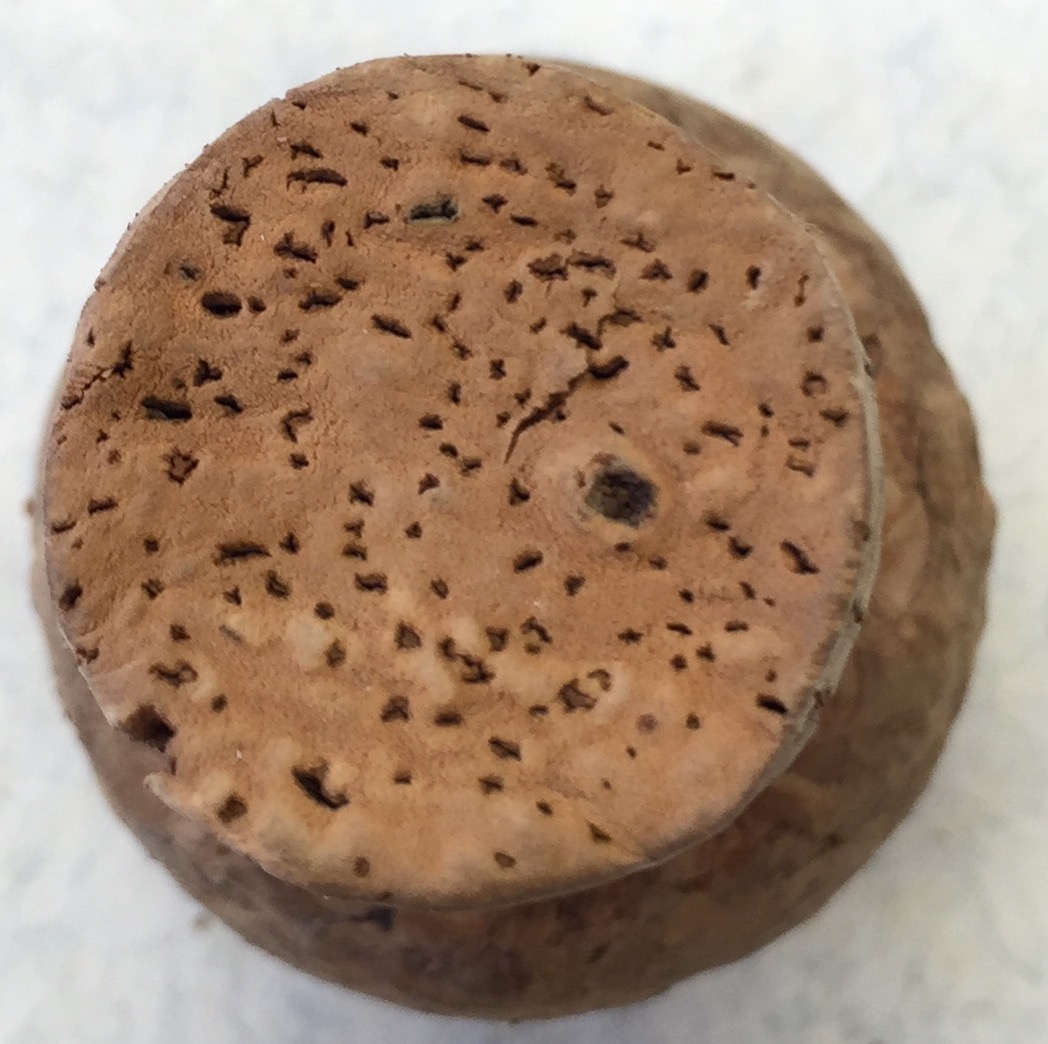
This champagne bottle cork (below) shows some similar ingenuity.
Champagne is carbonated wine and the bottle corks are mushroom shaped so that
the top overlaps the top of the bottle neck where it is wired down to keep the
cork in the bottle neck. The gas pressure within the bottle can push the cork out once the cork is loosened, carefully, and out pops the cork. The top is composed of cork pieces, but such
construction is not air tight. Two (or three) thin layers of real cork and glued
to the bottom, but as you can readily observe the lenticels are running the
wrong way! (Bottom of the cork shown below) This means the layers can be cut from a thin layer of bark, but they
won’t be air tight either. However, if 2 layers are are put one upon the other and rotated
relative to each other, the lenticels won’t line up from one layer to the
other thus making a functional cork out of bark that would otherwise be inadequate. Alternatively, they use plastic stoppers.