Field of Science

Two Tulips?

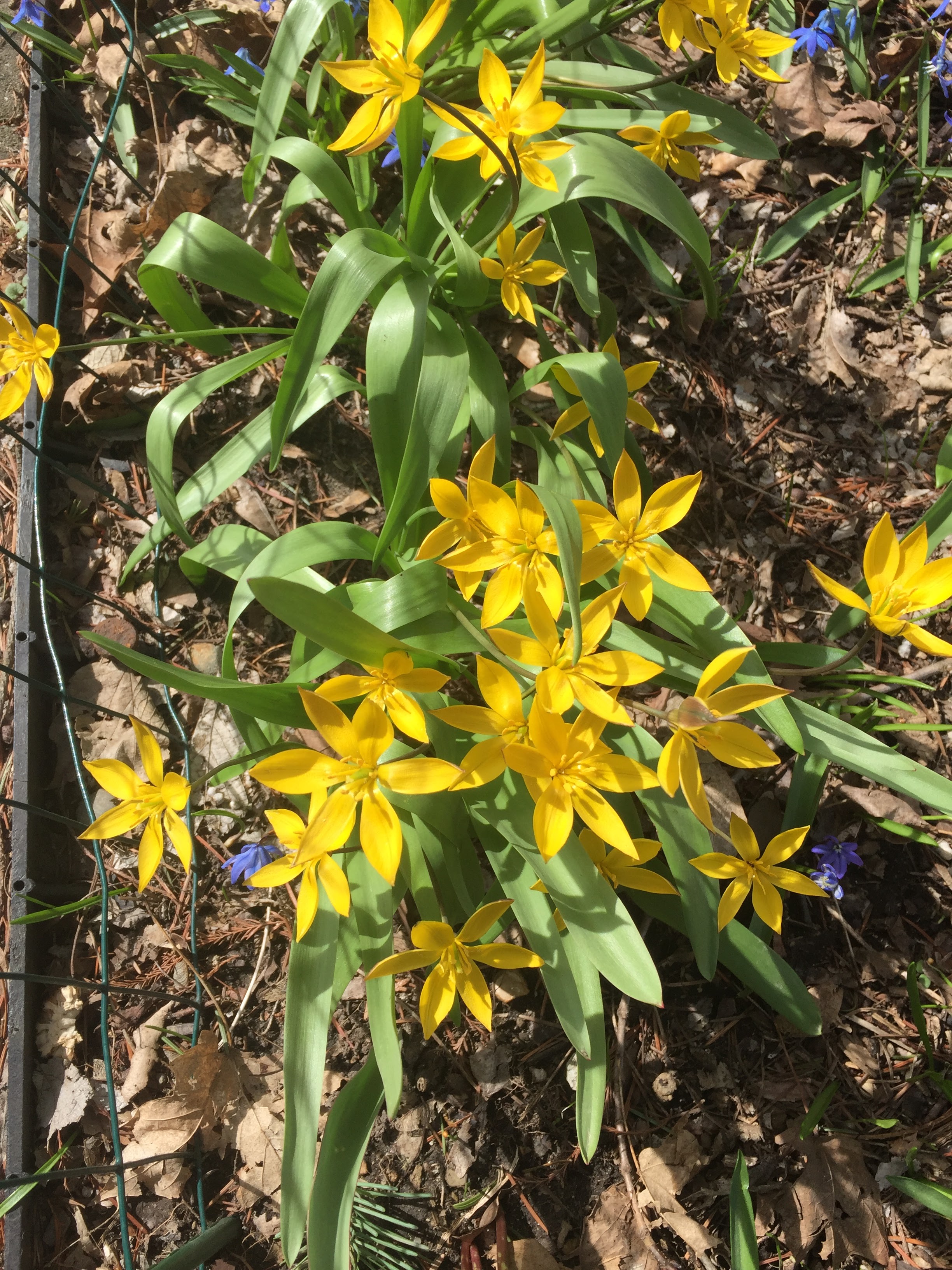
 Some time back Ms. Phactor planted a bag of mixed tulips, species tulips.  One species has done quite well and it is very cheerful, it is either Tulipa tarda (the late tulip?) or T. urumiensis (and they might be taxonomic synonyms), but TPP doesn't know tulip taxonomy very well.  The flowers only open when the sun is shining.


More pinky flowers

 OK we just celebrated peak blue, but some of the early flowering shrubs are making things pink.  The earliest flowering Magnolia in my collection is a hybrid (M. x loebneri); it looks a lot like a star Magnolia and that is one the two parent species.  The flowers are quite pink with fewer tepals and no smell at all.  The plant grows like a star Magnolia too.  


Friday Fabulous Flower - early spring color

 It's actually a Friday and TPP is posting a new blog.  Is this possible?  March was pretty warm, so now April is compensating by being rather cold. This FFF is a really nice shrub for early spring color so as you want pink.  This is a very tough plant, tolerant of midwestern soils, and it flowers at a very small size, but seldom does it grow much more than 4-5' tall.  Yet you seldom see this azalea for sale in a nursery, but it is widely available in catalogues.  It handles spring frosts very well even after the buds begin to show color.  The plant shown handled 23 F without any damage.  However it is  apparently tasty to shrub nibbling bunnies; so mine are caged.  Also oaks don't like it and even if it gets severely damaged by falling oak limbs it grows back pretty fast.  This is the Korean Azalea (R. mucronulatum) and the most common variety is 'Cornell pink'.  These shrubs do nicely in the middle of mixed hedge-row beds, and TPP highly recommends it.


Friday Fabulous Flower - early bloomers, but very cheerful

 Here is another harbinger of spring.  The Phactors have many dozens of bulbs in our gardens, many of them varieties of Narcissus, and most of these are fairly good at needing fairly little attention.  Some have the yellow perianth and corona that we would call "daffodils", but others are more exotic with orange colored flower parts that are not necessarily in evenly spaced whorls.  


Hello, spring

 Nothing quite says spring more than crocus.  They just barely peak above ground and up shoots a flower. For whatever reason the earliest crocus are always gold colored.  This makes them extra showy, except bees can't see this color like they can the white, striped, or lavender colored flowers.  This clump of volunteers decided to grow under  European beech tree.  It's a nice contrast the splash of color among the leaves and against the bark.  It flowered earlier than the FFF snow trillium but it isn't a native wild flower.  


Friday Fabulous Flower - Earliest wild flower


This little beauty is often missed because it blooms so early, March 16 this year.  This is Trillium nivale, often called the snow trillium.  The small scale was added to show how big this flower is.  Tucked in among leaf litter it must stand some 7-8 cm tall and the flowers are some 5-6 cm side.  Each flower sits a top a whorl of three oval leaves.  This is one of earliest native wood land wildffowers of this area.  TPP found this species in a woodland park much to everyone's surprise.


Last gasp of winter - snow

This time of year the upper midwest is subject to warring weather fronts generally from the south west and the northwest.  The latter tend to bring drier but colder weather, while the former bring in moisture, which falls depending upon the temperature as either a liquid or a solid or a wintery blend of both.  These tend to form long narrow weather tracks that can hit or miss us depending upon just where the track is.  This year has been rather snowy, and last night we got probably 3 inches that will melt very soon as warmer air replaces the colder.  A colleague new to these parts commented on the changeable weather and how sad it was that all their shoots got snowed on.  Snow is a great insulator and spring shoots do very well beneath a blanket of snow.  TPP worries more about shrubs and trees buds getting their tips frozen if the temperature gets too cold.  People are already asking about tomato and chili peppers plants and even a minimal freeze with kill these tropical plants.  Stick with the mustard family, the coleworts, and lettuces and other cold weather greens for at least another month unless you use something to cover them as they grow.  The good old boys used to say if your peas didn't get snowed on they weren't planted early enough. Of course our friends that moved to the "upper peninsula" can only dream of spring.  
 

Friday Fabulous FLower - Spring has sprung

 Spring has sprung but winter isn't over yet.  Signs of spring: earliet bulbs in flower like snow drops and winter aconite open in sunny places, mallard ducks return to lily pond like clock work (Mar 1st), and of course the FFF in flower, two varieties of witch hazel, Arnold's promise and DIane (orange-reddish frs). Very, very cheerful.


Happy Birthday Charles Darwin

 Yep!  It was Charles' birthday. And Abe Lincoln's and my kid sister too. So pretty easy to remember.  In times past we've had cake in the Herbarium but cake and a viral pandemic don't mix well.  And TPP gets  out all the Darwin books he owns just so students can see them.  Heck, it's getting so faculty don't own such things as books either.  Sadly books and journals used to be a measure of how good you were as a scholar.  Once a month a visit to a big library would help keep in touch with the literature and you would solicit reprint copies of really good papers by sending a postcard.  You would buy reprint copies to give away, now you just download a pdf copy.  As a graduate student at least you got mail with reprints.  Of course Charles wrote books, not a 8-10 page journal research article.  Well Happy  Birthday anyways, Chalres, you would not like how some things have changed.

Avoiding winter - the Big Tree

 Hey all, after last year's attempt to avoid winter failed (also in Texas), this year's trip managed to avoid a foot or so of snow, by going farther south.  So TPP found himself in Goose Island State Park, which features the largest live oak (Quercus virginiana).  It is truly a massive tree.  And then a few hundred feet away we spotted a couple of whooping cranes.  The tree has a sort of multiple trunks massed together for a circumference of nearly 40 feet.   The crown spreads some couple of hundred feet in all directions.   It has seen better days but is still an impressive tree (even if not very tall, only 44 feet).