in The Greenhouse
Showing posts with label desiccation. Show all posts
Showing posts with label desiccation. Show all posts
Water, water everything

This time of year is tricky for gardening especially when mild warm weather predominates, but things aren't growing so much. Gardens just don't look like it's the end of September out there, and it's easy to get lulled into complacency. So here's the thing: keep those newly planted trees and shrubs, especially conifers, well watered. Remember winter survival is more about desiccation than it is about cold. Deciduous plants drop all those water-wasting leaves, but most conifers are evergreen, and while their leaves have relatively small areas and correspondingly less water loss, as the air gets colder it gets drier and when the soil freezes water is really "hard" to take up. So it's easy to lose track of rainfall and let plants dry out too much before the cold really sets in. TPP is now certain that his prize conifer died during the winter not because of cold but because of the severe drought the summer before. And that combined with less well established roots was a deadly combination. Remember, half an inch of water a week is needed at a minimum to keep things growing well, and water those newly planted trees and shrubs deeply.
Friday Fabulous Fern - A botanical resurrection

 Any tourist to Florence Italy will get their
fill of resurrection because of the abundance of religious-themed art. But there’s another kind of resurrection that
is very common in these parts; so called “resurrection” plants or desiccation tolerant plants. Many ferns,
clubmosses, mosses, and leafy liverworts are capable of desiccation and rehydration, sometimes quite rapidly. In this part of Tuscany,
the agricultural and urban landscape is composed of wall after wall after wall
of mostly rough limestone blocks. There’s a lot of surface area there for tough
plants who can hang onto the wall by rooting into
the cracks and crevasses between or in the rocks. Such environments are pretty harsh, very
hot and dry, intermittently hospitable after rains or during a rainy season.
Quite a number of these desiccation tolerant plants can be found on the walls
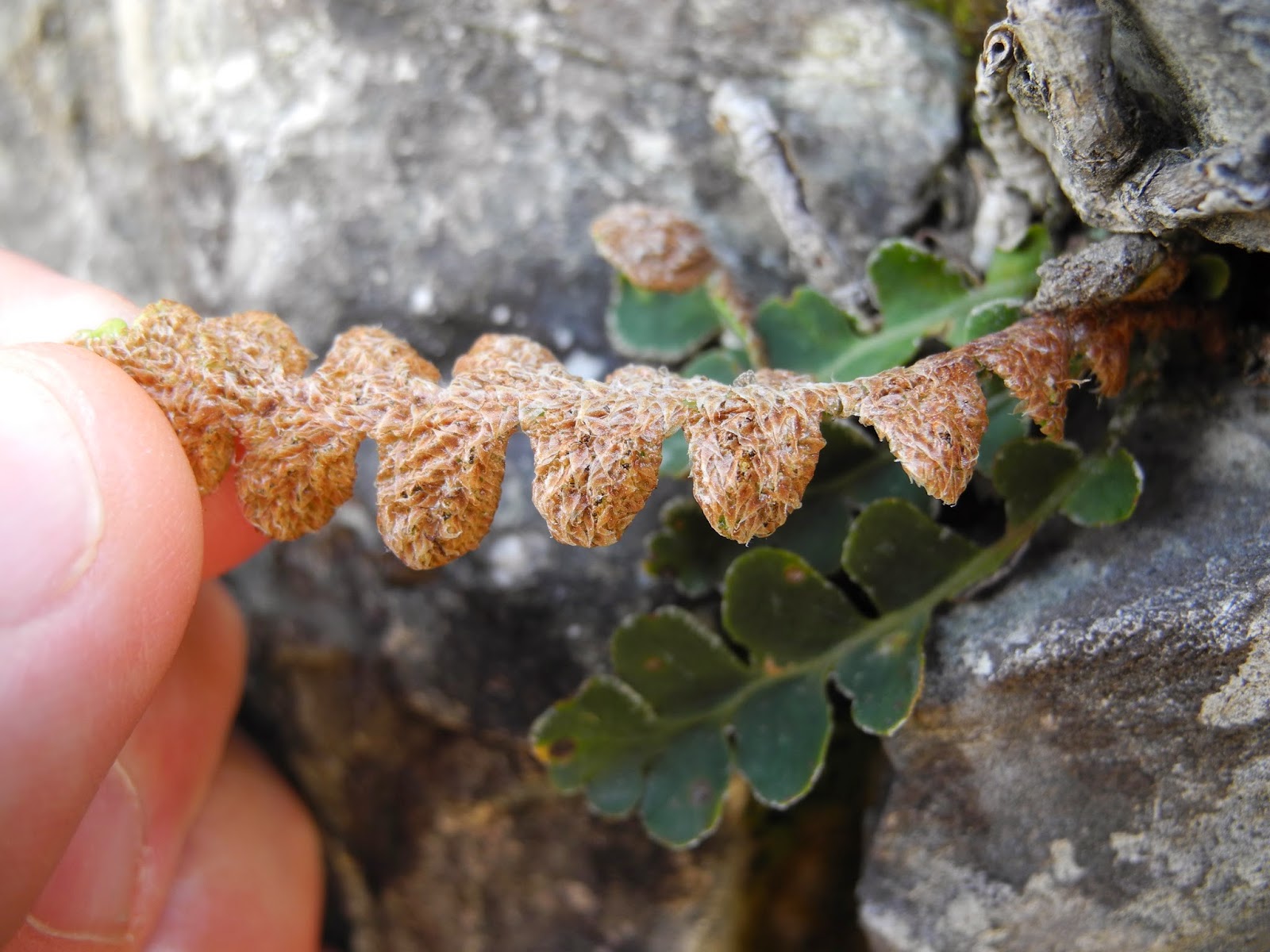
of this estate. The primary fern is
Asplenium ceterach, the rusty-backed fern, so called because the backs of the
leaves are covered with brown, scaly hairs that hide the sori. As the fern
dries out the pinnae (leaflets) and fronds curl such that the brown back side of the
leaves is exposed, and the fronds curl almost into a reverse fiddlehead. The hairiness
helps reduce water loss, perhaps reflects sunlight, and may speed rehydration by
trapping water in capillary spaces. When dehydrated these ferns seem like real crispy critters. Right now a little demonstration is
underway to see how fast some of these desiccated ferns can rehydrate. As expected some of the mosses are very fast
at this indeed. But within minutes the fronds begin to uncurl. 12 hours later the fern was rehydrated looking green and fresh. The non-botanists were quite impressed partly because the transformation is so striking, and partly because people have this idea that ferns are delicate little things.
Any tourist to Florence Italy will get their
fill of resurrection because of the abundance of religious-themed art. But there’s another kind of resurrection that
is very common in these parts; so called “resurrection” plants or desiccation tolerant plants. Many ferns,
clubmosses, mosses, and leafy liverworts are capable of desiccation and rehydration, sometimes quite rapidly. In this part of Tuscany,
the agricultural and urban landscape is composed of wall after wall after wall
of mostly rough limestone blocks. There’s a lot of surface area there for tough
plants who can hang onto the wall by rooting into
the cracks and crevasses between or in the rocks. Such environments are pretty harsh, very
hot and dry, intermittently hospitable after rains or during a rainy season.
Quite a number of these desiccation tolerant plants can be found on the walls
of this estate. The primary fern is
Asplenium ceterach, the rusty-backed fern, so called because the backs of the
leaves are covered with brown, scaly hairs that hide the sori. As the fern
dries out the pinnae (leaflets) and fronds curl such that the brown back side of the
leaves is exposed, and the fronds curl almost into a reverse fiddlehead. The hairiness
helps reduce water loss, perhaps reflects sunlight, and may speed rehydration by
trapping water in capillary spaces. When dehydrated these ferns seem like real crispy critters. Right now a little demonstration is
underway to see how fast some of these desiccated ferns can rehydrate. As expected some of the mosses are very fast
at this indeed. But within minutes the fronds begin to uncurl. 12 hours later the fern was rehydrated looking green and fresh. The non-botanists were quite impressed partly because the transformation is so striking, and partly because people have this idea that ferns are delicate little things.
Drought worrying at official start
It remains bone dry here in the upper midwest of the USA. January is almost at an end and the amount of precipitation has been way below average. This area has received none for the past 10 days or so. The ground is bare exposing ground level plants to the worse of the recent cold without any of the insulating properties of snow. For many years during my childhood a small mimosa tree/shrub survived in our garden just about 3 miles south of Lake Ontario in an area which was a hard zone five. My Mother was a southerner who really liked this reminder of the south, so it was planted where a snow drift reliably formed, and if you know anything at all about the snow belt of upstate NY, the snow is reliable. Any part of the mimosa sticking up got frozen, but the lower parts always survived. The temperature has reached zero, a funny designation in F degrees because that is 32 degrees below freezing. Come on people, can't we please switch to C like the rest of the world? At any rate this may kill some not so hardy plants, but more likely will be the death of plants, particularly newly planted ones, from desiccation. Yes, plants can freeze, but more damage and plant death comes from the dry conditions of winter than from the cold. So far our winter has been fairly mild with only one week of fairly cold temperatures so far. Our winters are basically desert conditions at low temperatures; December through February are the driest months here in terms of precipitation, about 2-3 inches a month tops. When the soil is frozen because of the lack of snow cover, even less water is available to plants. So it would appear that the drought, relieved somewhat during the fall, is continuing and looking forward this will make for a dry spring. Farmers will be happy about being able to get out onto their fields early, but this happiness will be short lived if the dry conditions continue. So TPP doesn't like the current conditions at all, so the official worrying has begun. It's a gardener thing.
A real resurrection (fern)
Is there a plant grower anywhere who has never accidentally let a plant dry out and die? Doh! Dehydration is such an annoyance. Yet there are a number of organisms that can dry out and survive quite well. Slime molds and yeasts can be dehydrated and survive for months. Some mosses and leafy liverworts can dehydrate, and rehydrate, on a daily basis, and sometimes for even longer periods of time. But when you get to vascular plants the ability to survive dehydration becomes rare perhaps because the whole idea of vascular tissue, cuticle, and stomata is to maintain a hydrated state, as long as the roots can replace the water being continually lost through transpiration. Of course comparing vascular plants to mosses and liverworts is not fair because the former are diploids and the latter haploids (explanatory link). But the point is that among vascular plants the ability to dehydrate and survive is rare, and no matter what, no one really seems to understand how even a slime mold can dehydrate into a brittle piece of yellow cytoplasm and then blob itself back to life when water is added.
One exception among vascular plants is the resurrection fern, Polypodium polypodioides. Sometimes they are sold as novelty items; just add water and the brittle fern rehydrates and greens up (see image). Cool. A recent report suggests that this ability is linked to appropriately named proteins called dehydrins, which appear to prevent cell wall damage from the “wrinkling up” that occurs when cells dry out. Could such a gene be used to engineer drought resistant crops? Maybe. And this is another example of why the powers that be, and that includes all of the people holding the purse strings, should encourage, rather than discourage, biologists to study a diversity of organisms. You can just imagine the derision a grant proposal would get from the USDA if you said you were going to study a cute little fern. Sure kid, how nice, now if you want money from us study corn, which never, ever suffers from droughts.
One exception among vascular plants is the resurrection fern, Polypodium polypodioides.
 Sometimes they are sold as novelty items; just add water and the brittle fern rehydrates and greens up (see image). Cool. A recent report suggests that this ability is linked to appropriately named proteins called dehydrins, which appear to prevent cell wall damage from the “wrinkling up” that occurs when cells dry out. Could such a gene be used to engineer drought resistant crops? Maybe. And this is another example of why the powers that be, and that includes all of the people holding the purse strings, should encourage, rather than discourage, biologists to study a diversity of organisms. You can just imagine the derision a grant proposal would get from the USDA if you said you were going to study a cute little fern. Sure kid, how nice, now if you want money from us study corn, which never, ever suffers from droughts.
Subscribe to:
Posts (Atom)