


 Clubmosses are a favorite group of plants, the oldest lineage of living vascular plants, relicts of the Devonian and Carboniferous, a glimpse into the primeval world. What a great group of organisms. They retain all sorts of features that used to be commonplace, but presently are unusual. They exhibit dichotomous branching, an equal branching into two axes, both the stems and roots. They have microphyllous leaves, leaves with a different origin than all the rest of vascular plants, although that origin is a bit uncertain. The morning was spent rounding up all the specimens, fossils, slides, perserved specimens, herbarium specimens, and live specimens. Integrating all of this is an educational challenge for the students, but e-portfolios in lieu of lab reports seems to help. The specimen show is a bit of an aerial shoot of Selaginella pallescens. It's an upright species that has its sporangia aggregated at the ends of shoots and somewhat differentiated sporophylls producing strobili, cones, with both megaspores and microspores in separate sporangia, and with some care they can be cultured into mature gametophytes, which after fertilization will produce new sporophytes.
Field of Science
-
-
Change of address1 year ago in Variety of Life
-
Change of address1 year ago in Catalogue of Organisms
-
-
Earth Day: Pogo and our responsibility1 year ago in Doc Madhattan
Showing posts with label clubmosses. Show all posts
Showing posts with label clubmosses. Show all posts
In lab today - clubmosses
 Clubmosses are a favorite group of plants, the oldest lineage of living vascular plants, relicts of the Devonian and Carboniferous, a glimpse into the primeval world. What a great group of organisms. They retain all sorts of features that used to be commonplace, but presently are unusual. They exhibit dichotomous branching, an equal branching into two axes, both the stems and roots. They have microphyllous leaves, leaves with a different origin than all the rest of vascular plants, although that origin is a bit uncertain. The morning was spent rounding up all the specimens, fossils, slides, perserved specimens, herbarium specimens, and live specimens. Integrating all of this is an educational challenge for the students, but e-portfolios in lieu of lab reports seems to help. The specimen show is a bit of an aerial shoot of Selaginella pallescens. It's an upright species that has its sporangia aggregated at the ends of shoots and somewhat differentiated sporophylls producing strobili, cones, with both megaspores and microspores in separate sporangia, and with some care they can be cultured into mature gametophytes, which after fertilization will produce new sporophytes.
Pond landscaping - glorious quillworts
 One of the side benefits of pond renovation is you have new spaces to landscape, and this includes aquatic plants. So JFTHOI the Phactor has decided to include a pot of quillwort, Isoetes. This little known clubmoss is more common that most people know because it grows in places where most people don't look very close and it doesn't stand out except to a trained eye. So this won't generate any rave reviews from people, but the point is knowing it's there. Quillworts are the last living representatives of an ancient lineage of arborescent clubmosses, now reduced to little wetland plants. And unless you've been frogging around down on your hands and knees in a shallow wetland, with an experienced botanist, you'll have never seen a quillwort. Of course, once you have, you'll say, "Uh, that's what we're down here frogging around in the mud and water for?" Yes! As you can see the long slender leaves look sort of reedy-rushy except for the sporangia that are embedded in the base of fertile leaves, but you won't see them without pulling one up. This is a big species with leaves a hand span long. Just the thought of having such an ancient plant growing in our pond will be a source of considerable satisfaction. Image complements of Show Ryu, Wikimedia Creative Commons.
Time to update my taxonomy and yours - Clubmosses

This is not a continuation of bryophyte seek; clubmosses are vascular plants. In fact clubmosses are the oldest lineage of vascular land plants, and those that exist today are sadly mere relicts of past diversity. Their taxonomy used to be pretty easy, and you only had to know a handful of genera, but splitters have been at work, whether justified or unjustified, and now the Phactor must learn some new names. Bother. Now Selaginella is not a particular problem, and as the oldest living genus, it’s taxonomy is  pretty well behaved, but not so with Lycopodium. Quite a number of its species have been transferred to other genera. First, Lycopodium (top) now consists of those species of clubmoss that have aerial shoots arising from a rhizome, bristly leaves arranged helically along an axis, and sporangia borne apically in distinct strobili, cones. Some 10-15 temperate to Arctic species that lack a rhizome and bear sporangia along the axis subtended by unmodified, or largely so, leaves, and therefore lack terminal strobili, are now in the genus Huperzia (middle - Image credit Dave Webb via the BSA). And then there’s Diphasiastrum (3d image) which by having scale-like,
  over-lapping leaves along the stems making them look rather flattened. Tropical species
  of Lycopodium that are largely epiphytic, but lacking a rhizome more or less befitting their growth habit, are now called Phlegmaria (bottom - image credit: Heaton's Ferns). Careful how you say it.
 pretty well behaved, but not so with Lycopodium. Quite a number of its species have been transferred to other genera. First, Lycopodium (top) now consists of those species of clubmoss that have aerial shoots arising from a rhizome, bristly leaves arranged helically along an axis, and sporangia borne apically in distinct strobili, cones. Some 10-15 temperate to Arctic species that lack a rhizome and bear sporangia along the axis subtended by unmodified, or largely so, leaves, and therefore lack terminal strobili, are now in the genus Huperzia (middle - Image credit Dave Webb via the BSA). And then there’s Diphasiastrum (3d image) which by having scale-like,
 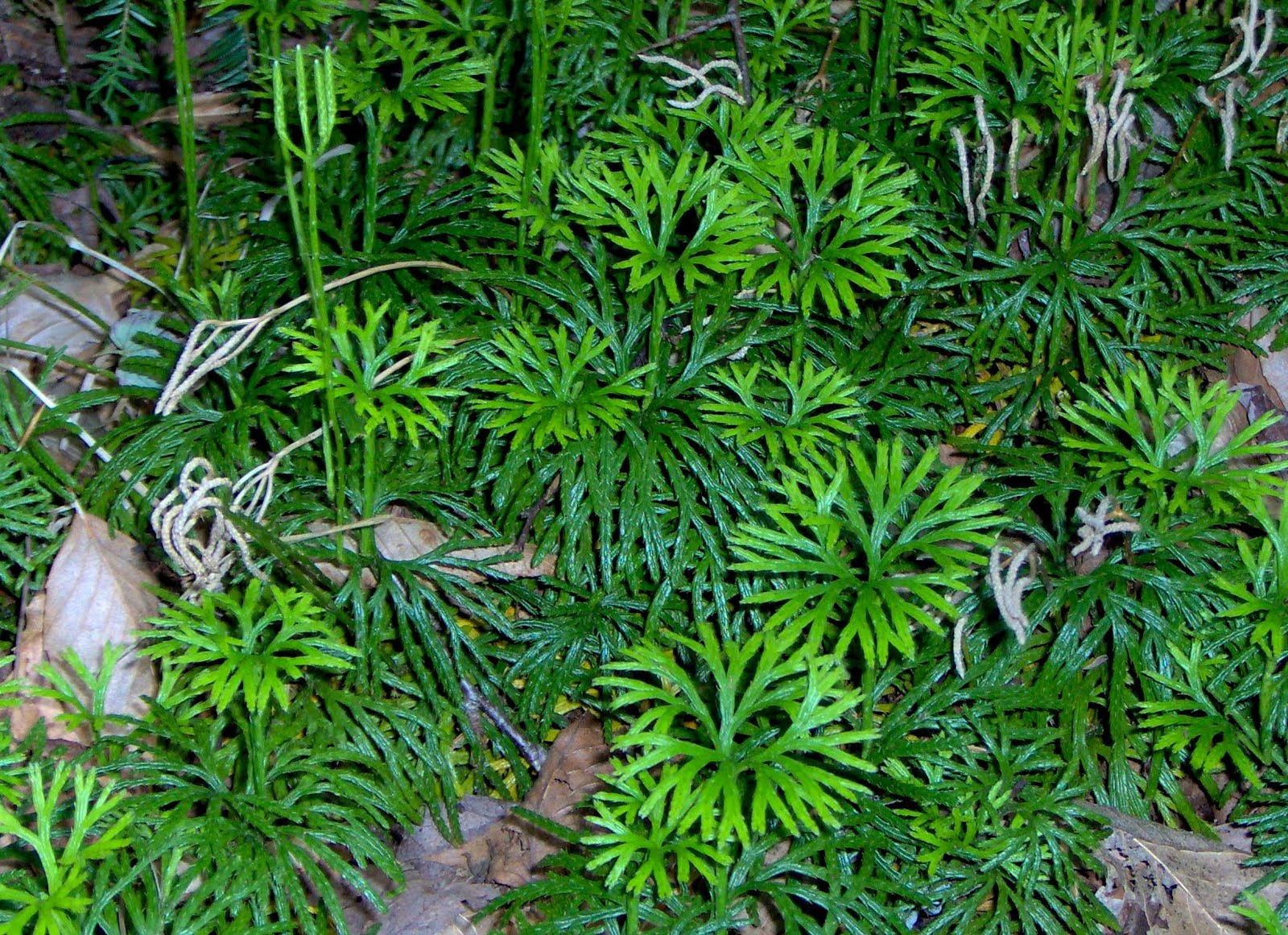 over-lapping leaves along the stems making them look rather flattened. Tropical species
  of Lycopodium that are largely epiphytic, but lacking a rhizome more or less befitting their growth habit, are now called Phlegmaria (bottom - image credit: Heaton's Ferns). Careful how you say it.
Subscribe to:
Posts (Atom)