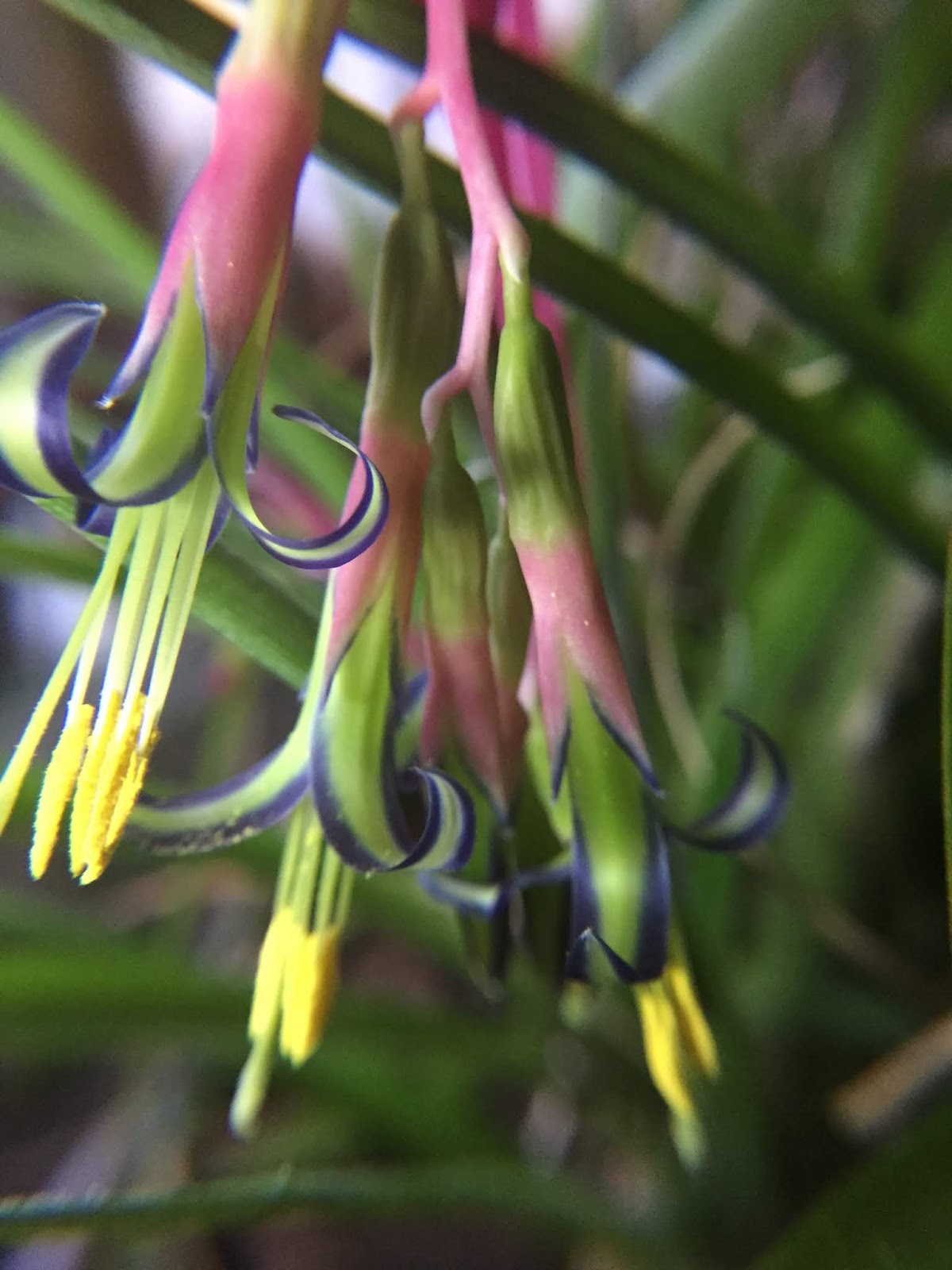
OK, it's only Thursday, but it's the 31st, and I'd probably not get a chance tomorrow. Those of you with good memories may recall that TPP has showed you this flower before (here) and maybe else where too. And for good reason. It's a real fabulous flower, and it just makes you feel good when this semi-scraggy bromeliad flowers. Now this year TPP repotted the plant because there was no soil, or orchidy growing mixture at all, just rhizomes. Gave away a rather large cluster of shoots, or two, and replanted the rest. New basket and replanted plant (Billbergia nutans) probably weighs 30-40 pounds without being soaked with water. And of course TPP wanted to play with his new iPhone macro lens some more. And so here it is. Isn't that a great combination of colors. The blue eye-liner petals are the niftiest thing.
- Home
- Angry by Choice
- Catalogue of Organisms
- Chinleana
- Doc Madhattan
- Games with Words
- Genomics, Medicine, and Pseudoscience
- History of Geology
- Moss Plants and More
- Pleiotropy
- Plektix
- RRResearch
- Skeptic Wonder
- The Culture of Chemistry
- The Curious Wavefunction
- The Phytophactor
- The View from a Microbiologist
- Variety of Life
Field of Science
-
-
Change of address1 year ago in Variety of Life
-
Change of address1 year ago in Catalogue of Organisms
-
-
Earth Day: Pogo and our responsibility1 year ago in Doc Madhattan
-
What I Read 20241 year ago in Angry by Choice
-
I've moved to Substack. Come join me there.1 year ago in Genomics, Medicine, and Pseudoscience
-
-
-
-
Histological Evidence of Trauma in Dicynodont Tusks7 years ago in Chinleana
-
Posted: July 21, 2018 at 03:03PM8 years ago in Field Notes
-
Why doesn't all the GTA get taken up?8 years ago in RRResearch
-
-
Harnessing innate immunity to cure HIV10 years ago in Rule of 6ix
-
-
-
-
-
-
post doc job opportunity on ribosome biochemistry!11 years ago in Protein Evolution and Other Musings
-
Blogging Microbes- Communicating Microbiology to Netizens11 years ago in Memoirs of a Defective Brain
-
Re-Blog: June Was 6th Warmest Globally12 years ago in The View from a Microbiologist
-
-
-
The Lure of the Obscure? Guest Post by Frank Stahl14 years ago in Sex, Genes & Evolution
-
-
Lab Rat Moving House14 years ago in Life of a Lab Rat
-
Goodbye FoS, thanks for all the laughs15 years ago in Disease Prone
-
-
Slideshow of NASA's Stardust-NExT Mission Comet Tempel 1 Flyby15 years ago in The Large Picture Blog
-
in The Biology Files
A plant pundit comments on plants, the foibles and fun of academic life, and other things of interest.
Showing posts with label bromeliad. Show all posts
Friday Fabulous Flower - Queen's tears once again
Sorry about the repeat of this FFF, but this is one of TPP's favorite house plants and it flowers when this blogger is hard up for material. The Queen's tears is the common name of Billbergia nutans, a member of the pineapple/bromeliad family. And the flowers are just so darned lovely. You just have to love the blue eye liner margins of the green petals emerging from pink sepals and bracts. Even the yellow exerted anthers show up so nicely. It gives us something to look forward to in the winter.
Friday Fabulous Flower - Queen's Tears
The Queen's tears (Billbergia nutans) is without question TPP's favorite winter flowering house plant. It's been feature on FFF before, so it's just something to look forward to each year. This year more than a dozen of the pink inflorescences emerged from within whorls of leaves, and tonight the Phactors are hosting and open house, so a few plant fanciers will get a treat. The flowers are just so attractive with their blue eye-liner petals and pink sepals. So hoping you enjoy this as much as TPP.
Friday Fabulous Flower - An Air Plant
Often called and sold as an air plant, generally meaning an epiphyte that does not need soil, this is a popular and fairly common bromeliad (pineapple family), Tillandsia bulbosa. The leaf bases overlap each other forming a bulbous base. The leaves are quite waxy and the blades are rolled into a cylindrical shape that sort takes on a sinuous arrangement. Such adaptations reduce water loss and perhaps capture and store water in the modified bulbous tank. At least one author has suggested it might also be an ant plant, but TPP has not verified this elsewhere. The red inflorescence is the primary attraction and it lasts a long time providing a attractive platform for the handsome but not so gaudy purple flowers. The white stigmas and yellow stamens with purple filaments protrude from the tubular flowers. In the humidity of our glasshouse this plant thrives; in a dry household it would be more of a challenge to grow. Suggestion: hang it in the stall when you shower.
Friday Fabulous Flower - Queen's tears
The Queen's tears is a commonly and easily grown bromelliad. TPP's sits happily in a hanging basket outside for the summer until things get frosty. Then it comes inside, and almost without fail it flowers in January. The flowers don't last long but it is still such a winter time joy. TPP has featured this plant before (Billbergia nutans) because it has such an odd combination of colors, pink bracts, flowering stalk, and calyx, green ovary and green petals edged in blue, and the yellow anthers. Several such inflorescences ring the basket and the whold thing is quite lovely, so do forgive the redundancy; it's just nice to see every year.
Damn big bromeliad
Friday Fabulous Flower - a bromeliad
This time of year regular visits to our glasshouse help your mental health. The greeness, the humidity, the earthiness are all very comforting and rejuvenating because it's so alive. Quite a few of these tropical plants flower during our winter season, which is sort of strange if they are generally day-neutral. At any rate, here's a rather nice Friday Fabulous flower, a largish flowered bromeliad (pineapple family) that has been in our collection for decades. It's never been labeled and so TPP simply must make a guess based on some general features that it's Billbergia pyramidalis. The 3-parted corolla always has a bluish tinge to it, which together with the 3 pale pink sepals and all the pink bracts on a fist-sized inflorescence makes for quite a display standing above the vase-like whorl of leaves. The stigma and stamens are exerted from the corolla to make contact with the head of a pollinating hummingbird. Enjoy.
Subscribe to:
Posts (Atom)