


Field of Science
-
-
Change of address1 year ago in Variety of Life
-
Change of address1 year ago in Catalogue of Organisms
-
-
Earth Day: Pogo and our responsibility1 year ago in Doc Madhattan
Friday Fabulous Flower - Mallow

One of the larger and gaudier flowers that you can easily raise is the rose mallow (Hibiscus mosacheutos). Like all related flowers the large number of stamens forms a tube through which the style grows bearing a branched 5-parted stigma. The flowers are huge, 8-9" across, and they are white, pink, rose, or red with red highlights (nectar guides) in their centers. Often this time of year when the rose mallows flower, the Japanese beetles appear and chew the crap out of the mallows and quite a few other plants too, although they do love the mallows. This year for some reason the beetle population is quite small, do little to no damage. These are herbaceous perennials, so they die back to the ground and grow new aerial shoots each year.

Friday Fabulous Flower - Bottle Brush Buckeye
S pring flowering peters out through June until summer flowering plants sort of take over, but it isn't quite the same. Lots of prairie natives flower in the summer, but not nearly as many shrubs or bushes flower in the summer. Here's an exception, and if you don't have one, you need to rethink your garden. Right now in mid-July, our bottle brush buckeyes (Aesculus parviflora) look great, and they grow OK on edges and in light shade. This shrub has probably the showiest floral display of any shrub that can grow on a light shade border. They can get a bit taller than many people would like, and they do spread a little after awhile but no so much it is considered a problem. These long (over a foot in length) inflorescences just cover the plants and contrast nicely with dark green foliage. Japanese beetles have been a problem before, but hardly any beetles this season. Our plants were seedlings and it was a very slow start, so buying bigger plants, paying someone else to grow them, is a good idea. The plant is a native to SE USA, but they seem quite cold hardy.
 pring flowering peters out through June until summer flowering plants sort of take over, but it isn't quite the same. Lots of prairie natives flower in the summer, but not nearly as many shrubs or bushes flower in the summer. Here's an exception, and if you don't have one, you need to rethink your garden. Right now in mid-July, our bottle brush buckeyes (Aesculus parviflora) look great, and they grow OK on edges and in light shade. This shrub has probably the showiest floral display of any shrub that can grow on a light shade border. They can get a bit taller than many people would like, and they do spread a little after awhile but no so much it is considered a problem. These long (over a foot in length) inflorescences just cover the plants and contrast nicely with dark green foliage. Japanese beetles have been a problem before, but hardly any beetles this season. Our plants were seedlings and it was a very slow start, so buying bigger plants, paying someone else to grow them, is a good idea. The plant is a native to SE USA, but they seem quite cold hardy.
 Friday Fabulous Flower - Stokesia
Most sources indicate that Stokesia is a type of aster, all this means is that all of the flowers have a bilaterally symmetrical corolla, the flower form that is located around the periphery of daisy-type flowers as opposed to the cenral button composed of radially symmetrical flowers. There is only one species, so TPP suspects that someday someone will figure out its relatives and it will get shuffled into another genus. Stodesia is an honorific name, honoring an early physician who had some botanical leanings, Jonathon Stokes. This plant is native to the coastal plain of southeastern USA, but is a pretty adaptable ornamental, and reasonably tough in both its ability to deal with drought and cold (zone 5). It is a fairly short plant in our experience so it gets used on margins of paths. The flowers come in a number of shades of purple, as well as pink and white. Note the white, t-shaped stigmas protruding from all the central flowers.


Drpught, dry, dry, dry, cracked earth, and hot temperatures
What a great time to be a gardener, it gives us something to do that is pretty low risk for us senior citizens. Our gardens need water, lots of water, and the lily pond too. Oh, things that can be easily watered are doing well enough like boxed, caged tomatoes. But the Phactors do not waste water on lawn, which is on its own. Everything is wilting to some degree, and if it doesn't recover over night then it really needs to be watered the next day. Plants like the big-leafed Magnolias have a lot of surface area and can lose a lot of water. And other things are rather new and as yet don't have extensive root systems, like our newest plum yew and an Abelia, and a white snake root. So a good deal of TPP's daily activity is pulling hoses around to ward off the worst on the drought. Gave an older hose and a soaker hose to the F1 because her whole garden is new. Even now a timer is telling TPP to get going and move the sprinkler to a new area in an attempt to rejuvenate a double-file Viburnum, that is trying to recover from a winter die-back. Already lost a dwarf Metasequoia from the Japanese garden; it has never been a happy camper, so no surprise really. In a real surprise, the prairie nursery TPP has inherieted had some bunchflower blooming (Melanthium virginicum), which TPP has never seen before. Quite handsome. Hope to propagate some more this coming year.
Friday Fabulous Flower - Who's wort?
OK This is a little bit weird. TPP is never a day early with a FFF. Mrs. Phactor pointed out that yellow flowers with lots of stamens is a bit of a theme recently, and all in our front garden. Both the cactus and peony a few posts below fall into that category. This particular flower is an evergreen shrub with a bluish-green foliage. It's quite a handsome plant and the bees just love it. Some species of this genus almost all with the general common name of St. John's wort, are native in our flora, but this one, Hypericum kalmianum, is native to the Great Lakes region, so a bit north of here. Obviously it is quite hardy, and this particular one is an ornamental variety, basically trouble free and much recommended. Ours is about 4 feet wide by 2.5 feet tall.


Gardening in a time of plague: Chapter 3
Summer is upon us, and so is a mild drought. Our city is raising water rates, so it will be getting more expensive to keep gardens watered. It takes a minimum of 1/2 inch of rain a week to keep gardens going. Sensitive plants need more water, some are better at dealing with dry conditions than others. Two senior citizens did manage to distribute 2.5 yards of wood mulch onto gardens and paths to make things look much better. Several plants are candidates for relocation, but until the soil moisture gets better it is a risky undertaking. The Phactors have decided that ostrich fern should be added to the list of never plant this plant. It looks OK but it's rhizomatous and tends to take over whole gardens.
New additions do get preferential treatment when is comes to water. Until they get well rooted you have to keep watering them. Nothing too delicate has been added to our gardens making it pretty easy to keep up. A couple of small hostas are an exception but being small means watering them is not a major project.
A largish patch of Sorbaria, the so-called false Ural spirea, sort of looks like a sumac, but has fuzzy looking plumes of white flowers. It's close to being on the do not plant this plant list; it is a spreader and was threatening to consume a neighbors' garage. The trespassing portion was removed and a couple of hosta were found in the process. Unless you have room for such plants, do not plant them.
At least gardening gives us an outdoor activity and exercise. And weeding helps you maintain a healthy frame of mine, giving the opportunity to get rid of poor choices without getting depressed over politics. The amount of damage one person can do in just 3 years is hard to believe. A niece is getting married in July and in October. The earlier event if just too untimely for us presently and we hope things are better in 3 more months. Sadly this is part of the havoc wrought by this pandemic. And mostly all you can do is to keep the gardeners well supplied with margaritas, a nice self-sterilizing liquid. A few people have visited to have a socially-distanced reprieve to break up the quarantine a bit. It's outside and the gardens are big.
New additions do get preferential treatment when is comes to water. Until they get well rooted you have to keep watering them. Nothing too delicate has been added to our gardens making it pretty easy to keep up. A couple of small hostas are an exception but being small means watering them is not a major project.
A largish patch of Sorbaria, the so-called false Ural spirea, sort of looks like a sumac, but has fuzzy looking plumes of white flowers. It's close to being on the do not plant this plant list; it is a spreader and was threatening to consume a neighbors' garage. The trespassing portion was removed and a couple of hosta were found in the process. Unless you have room for such plants, do not plant them.
At least gardening gives us an outdoor activity and exercise. And weeding helps you maintain a healthy frame of mine, giving the opportunity to get rid of poor choices without getting depressed over politics. The amount of damage one person can do in just 3 years is hard to believe. A niece is getting married in July and in October. The earlier event if just too untimely for us presently and we hope things are better in 3 more months. Sadly this is part of the havoc wrought by this pandemic. And mostly all you can do is to keep the gardeners well supplied with margaritas, a nice self-sterilizing liquid. A few people have visited to have a socially-distanced reprieve to break up the quarantine a bit. It's outside and the gardens are big.
Friday Fabulous Flower - Prickly subject
This is a native plant to Lincolnland and it grows naturally fairly close by around the Havana sand priaries to the SW of us. This plant is tough as nails and you just need a sunny, well-drained area to grow it. Basically this is a near prostrate succulent shrub. The flower is fairly large and certainly is part of our unintended theme of big yellow flowers.
This is a prickly pear cactus, Opuntia humifusa. This image also shows the modified leaves quite well to the left of the flower. These will not persist. Sometimes you see plants where the flowers have a much redder center, but the smaller bees (green ones TPP usually associates with leaf-cutting) was observed just wallowing in all those anthers. Regretably the flowers do not last long, but a plant can flower prolifically with lots of flowers. This is a first time event for our gardens and the plant a relative newcomer (3d year).

This is a prickly pear cactus, Opuntia humifusa. This image also shows the modified leaves quite well to the left of the flower. These will not persist. Sometimes you see plants where the flowers have a much redder center, but the smaller bees (green ones TPP usually associates with leaf-cutting) was observed just wallowing in all those anthers. Regretably the flowers do not last long, but a plant can flower prolifically with lots of flowers. This is a first time event for our gardens and the plant a relative newcomer (3d year).

Friday Fabulous Flower-Shade loving
TPP was poking around in the shady recesses of our gardens and there under a huge burr oak and a bottle brush buckeye (that is in heavy shade), he found this member of the Logania family. In actual fact this may be the only member of the Logania family that is native to Lincolnland. And it is a stunner of a native plant that only recently has found its way into native plant nurseries. This is Spigula marilandica, the Indian Pink. Wow! Does this flower stand out in heavy shade? This is only the second year it has flowered, so it's still a bit exciting.


Friday Fabulous Flower - Floriforous native
TPP has missed Friday again, but this was ready and the image is from last Friday. You plant natives because generally they are tough, but this one also provides gobs of colorful flowers. TPP first saw this species on road cut embankments on a trip west. And it required a stop for a bit of roadside botany. It's pretty easy to identify this plant family, Onagraceae, the evening primrose family. The flowers are large and they have a long floral tube, which is the kind of thing you associate with hawkmoth pollination. This used to be called Oenothera missouriensis, but now it's O. macrocarpa. This plant is just behind a south-facing retaining wall, so the spot is hot and prone to be dry. The plant is only about 1 foot tall and wide (see the knock-out rose provided for contrast and size comparison) and yet it has about 2 dozen flowers open. And they are all a bright, clear yellow in color. Individually they don't last long but flowering could go on for another 2-3 weeks. While native it is listed as quite rare here in Lincolnland. Cultivars are routinely sold and it is perennial.


Friday Fabulous Flower - Still one more peony
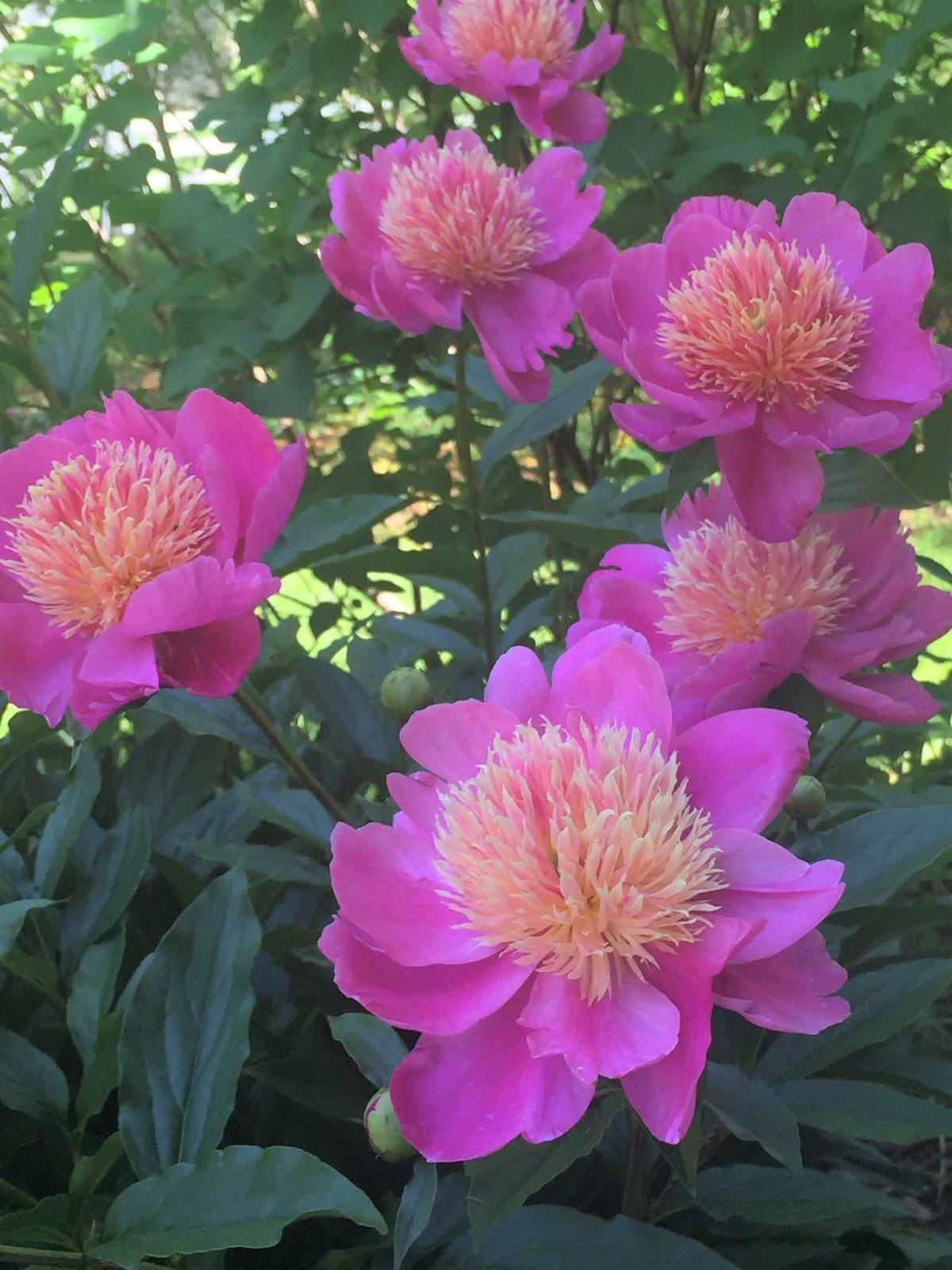
Well, it is almost the end of May and TPP forgot some of the herbaceous peonies still to flower. This particular peony is quite spectacular. It is a big, tall plant with a goodly number of flowers making for quite a display. This is also an anemone-type flower where the many stamens were developmentally transformed in to staminodia, sterile appendages that make for a crown like structure in the center of the flower. What a color! Hot pink.

Subscribe to:
Posts (Atom)